
Reviewed · JEWISH QUARTER TOURS
Jewish Heritage in Hungary with a Historian
Budapest’s Jewish Quarter is much more than a row of handsome synagogues. It is a place where medieval trade, Orthodox tradition, wartime courage, modern nightlife, and Jewish baking all meet within a few city blocks. This 2.5-hour walking tour gives you that wider story, guided by a historian rather than a guide who simply points at façades.
I especially like the small group limit of 10, which makes it easier to ask questions, and the way the route joins serious history with everyday Budapest life at Szimpla Kert and Gozsdu Udvar. The main drawback is important: you see the Great Synagogue from outside rather than entering it, and admission to the synagogues is not included.
Key points to know before booking
- A historian leads the walk: Guides including Andrea, Gabor, Barbi, Noémi, and Andras have led this experience, with a focus on clear explanations and open questions.
- The route covers more than the Holocaust: You hear about Jewish life in Hungary across many centuries, including the Orthodox community and the years from the seventeenth century to the present.
- The group stays small: A maximum of 10 people gives the tour a personal, conversational feel.
- Three important synagogues appear on the route: Rumbach Street, Kazinczy Street, and Dohány Street, with the first two discussed in more detail and the Great Synagogue viewed from outside.
- Modern Budapest is part of the story: Szimpla Kert and Gozsdu Udvar show how the old Jewish Quarter functions today.
- A local pastry is included: You finish with flódni, a traditional Jewish-Hungarian cake, at Solinfo Café.
Why this Jewish Quarter walk feels different
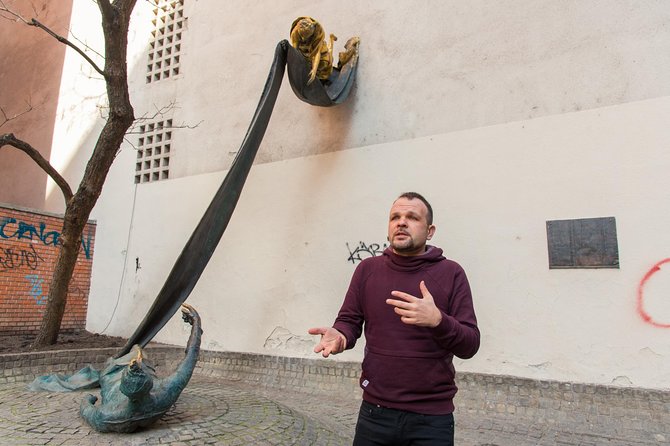
Many city tours treat Budapest’s Jewish Quarter as a short stop on a broader sightseeing route. This one gives the area room to breathe. You begin near Erzsébet tér and finish outside the Dohány Street Synagogue, following a route that links public squares, memorials, nightlife spaces, religious buildings, and food.
That mix matters. Jewish Budapest is not only a story of persecution and loss, though the difficult years of the 1940s receive serious attention. It is also a story of community life, religious differences, cultural influence, survival, and the way the district has changed in recent decades.
The guides appear to take different personalities onto the route. Andrea is described as warm and attentive, Gabor as clear and especially strong on the long historical narrative, Barbi as someone who puts the tragic twentieth century into a much older setting, and Noémi as enthusiastic about the Jewish Quarter itself. Andras is noted for making links between past events and current affairs. Your guide will depend on the date, but the format is built around conversation rather than a memorized speech.
At $64.71 per person, this is not the cheapest way to stroll through the district. Still, the price is easier to justify if you want context, a small group, and a guide who can answer questions. You are paying for interpretation, not simply for access to buildings. Since the synagogue entry fees are not included, budget separately if you plan to visit one afterward.
More Jewish Quarter walks:
- Budapest Jewish Heritage Memorial Walking Tour & Synagogue Entry
★ 5.0 · 568 reviews - Budapest: Jewish Heritage Guided Tour with Synagogue Ticket
★ 4.8 · 533 reviews - Jewish Quarter of Budapest Walking Tour
★ 4.7 · 369 reviews
Starting at Erzsébet tér and meeting Budapest’s past
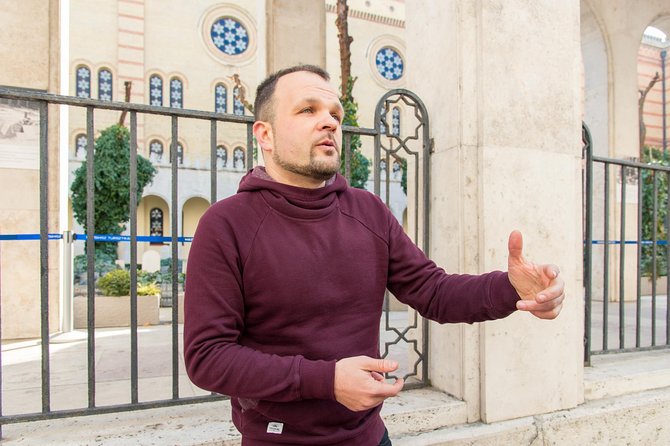
The tour starts at 10:00 am outside the Kempinski Hotel Corvinus Budapest at Erzsébet tér. The square is a useful central meeting point in Pest, and the first 20 minutes introduce the area through its earlier role as a medieval market square.
That opening is a good choice. It gives you a sense of how the city grew before the Jewish Quarter became known for its synagogues, cafés, bars, and cultural venues. You begin with urban history rather than rushing straight to a religious building.
The route is on foot, and the listed timing suggests a steady pace with frequent stops. Wear shoes you can walk in comfortably. The tour lasts about two and a half hours, so you should also plan for standing outdoors and moving between several nearby streets.
Raoul Wallenberg and the human choices of wartime Budapest
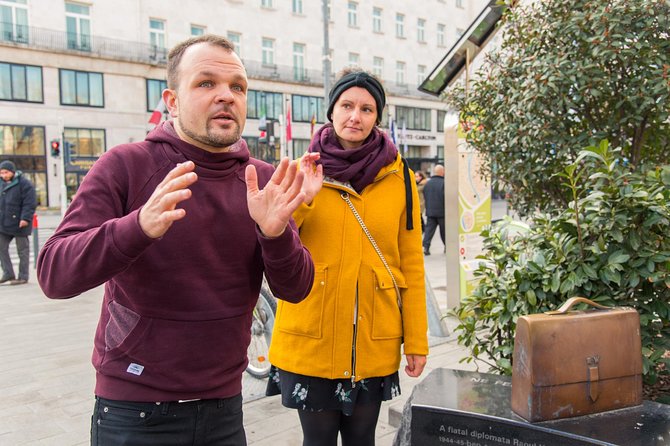
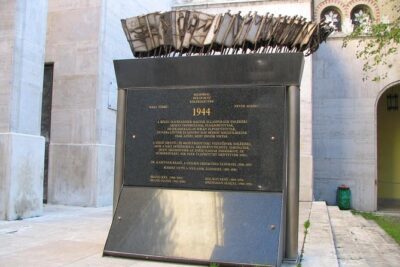
After Erzsébet tér, the group pauses for about 10 minutes at the statue of Raoul Wallenberg. The discussion focuses on the Swedish diplomat who helped save Jewish lives during the Second World War.
This stop gives the tour a human scale. Large figures and dates can make wartime history feel distant, while a memorial to one person opens a conversation about courage, responsibility, and action under pressure. The guide also places Wallenberg’s work within the wider story of Hungary’s Jewish population during the 1940s.
The timing is brief, but the stop is not filler. If you are especially interested in wartime Budapest, use this moment to ask how Wallenberg’s work fits with the other efforts to protect Jewish people in the city. The guide’s willingness to answer questions is one of the strongest reasons to choose a small group rather than a large city walk.
Szimpla Kert shows the quarter’s modern life
The next stop is Szimpla Kert, the ruin bar credited with starting Budapest’s ruin-bar trend. You spend about 20 minutes here, and admission is free.
This may seem like an odd pairing with Jewish history, but it makes sense on the ground. The Jewish Quarter is not a preserved museum district. It is a living part of Budapest, and Szimpla Kert helps you see its present-day energy and changing identity.
You should not expect a full bar experience during the tour. The stop is used to explain the venue and its place in the district. It also gives you a chance to see one of Budapest’s most famous modern gathering places without having to plan a separate visit.
For some people, this is the tour’s best balance of old and new. Others may find the ruin-bar stop less relevant than the synagogues or memorials. That is a fair concern, but the inclusion helps prevent the walk from presenting the quarter as only a site of mourning.
A few more Budapest half-days to weigh up
- Budapest: Historic Cruise with Welcome Drink
★ 4.7 · 6,512 reviews - Budapest Historical Sightseeing – Free Walking Tour
★ 5.0 · 1,302 reviews - Buda Castle District Dark History, Legends and Vampire Night Tour
★ 4.5 · 1,240 reviews - BloodThirsty Hungary: Walking tour & Dark Historical Stories
★ 4.9 · 633 reviews
Gozsdu Udvar and the district today
The route continues to Gozsdu Udvar, where the group spends about 10 minutes. The passage is described as one of Budapest’s most international streets, and it offers another look at how the neighborhood functions now.
This is a short stop, but it reinforces a useful point: districts change hands, uses, and reputations. The streets around the synagogues now contain restaurants, bars, shops, and nightlife, yet the religious and historical layers remain close by.
I like having both Szimpla Kert and Gozsdu Udvar on the route because they make the quarter easier to understand as a real neighborhood. You are not simply looking backward. You are seeing how Budapest uses these streets today.
Kazinczy Street Synagogue and Orthodox Jewish life
At Kazinczy Street Synagogue, the guide spends about 20 minutes explaining the Orthodox Jewish community. Admission is not included, so this part should be understood as an exterior or area visit unless you arrange entry separately.
The value here is distinction. Jewish communities are not all alike, and the guide uses Kazinczy Street to explain Orthodox life within the larger Jewish story of Budapest. That makes the synagogue more than an architectural photo stop.
Because entry is not included, confirm your expectations before booking. If your main goal is to see the interior of Budapest’s synagogues, this walk alone will not provide that. If your goal is to understand the district and decide which buildings you want to visit later, the stop works well.
Rumbach Street and Dohány Street in the wider story
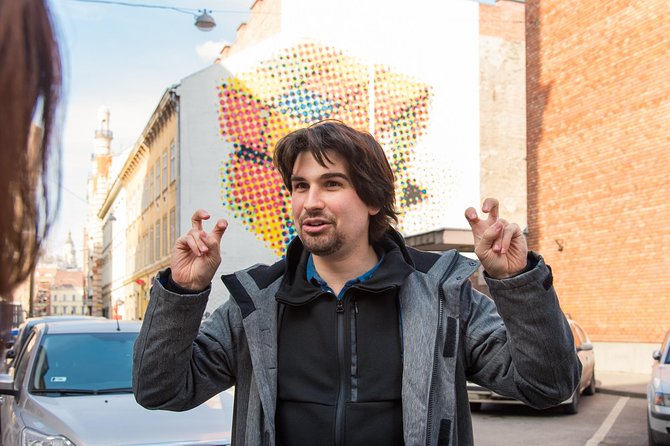
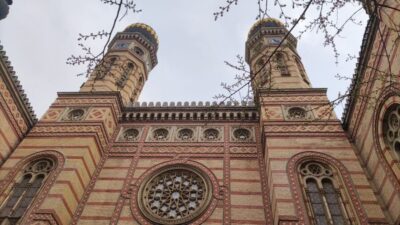
The route also passes the Rumbach Street Synagogue and the Dohány Street Synagogue. These buildings help create the visual spine of the Jewish Quarter, and the guide uses them to explain the area’s religious and cultural importance.
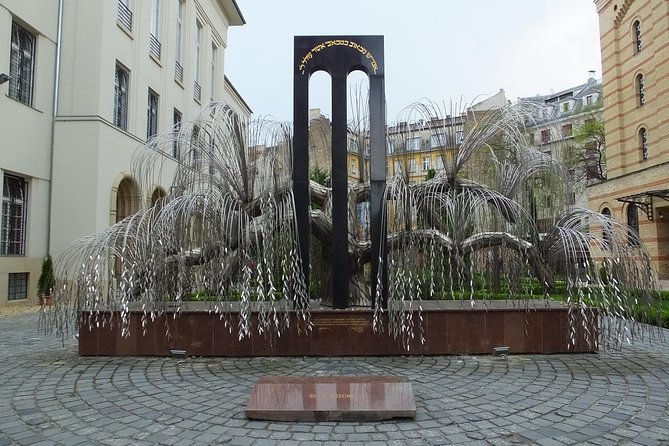
The Great, or Central, Synagogue on Dohány Street receives about 45 minutes of attention, but the group does not go inside. It is described as Europe’s largest synagogue, with major historical associations reaching across roughly the last 200 years.
That outside-only format is the biggest limitation of the experience. Dohány Street Synagogue is one of Budapest’s major sights, and many people will want to see its interior, grounds, and memorial areas. You will need a separate visit if those are priorities, and the admission fee is not part of this tour.
Still, an exterior discussion can be worthwhile when the guide explains what you are seeing and why the building matters. You get a framework for a later self-guided or paid interior visit. The tour ends outside Dohány Street Synagogue on Wesselényi utca, which makes that follow-up visit convenient to arrange.
Flódni at Solinfo Café
The final scheduled stop is Solinfo Café, where a portion of local Jewish cake, flódni, is included. The visit lasts about 20 minutes, and the pastry is described as a favorite among Jewish and non-Jewish people in Hungary.
Food is a smart way to finish this kind of walk. After several hours of dates, communities, buildings, and wartime events, a taste of something connected to local Jewish culture gives the subject a more ordinary and personal ending.
The included pastry also adds a little value to the ticket price. It is not a full meal, so do not arrive expecting lunch, but it gives you a chance to try a specific Hungarian Jewish food rather than simply hearing about it.
If you enjoy using food to remember a place, make a note of flódni so you can look for it again during your stay. The tour gives you an introduction, not a full food crawl.
What the small group changes
The maximum group size is 10. That limit matters most on a history-focused walk, where the quality of the experience depends on whether you can hear the guide and ask questions.
A small group also gives the guide room to respond to the interests of the people present. Past guides have been praised for patience, kindness, clear storytelling, and honest treatment of both the good and bad parts of Hungary’s past. One particularly strong account describes Gabor discussing Jewish life from the seventeenth century to the present with great detail and care.
You should still keep your expectations practical. A two-and-a-half-hour walk cannot cover every part of more than 800 years of Jewish life. The guide will offer a strong outline and selected stories, but you will not leave with a complete academic study of Hungarian Jewish history.
The small format is also a good fit if you prefer asking questions that might feel awkward in a larger group. The subject includes religious differences, antisemitism, collaboration, rescue, loss, and modern identity. A thoughtful guide can handle those subjects with greater care when the group is small.
Price, timing, and who gets the most value
The $64.71 price is reasonable for a private-feeling historical walk with a group of no more than 10, especially since a historian guide leads it and flódni is included. It is less attractive if you mainly want synagogue interiors, because the key admission fees are extra and Dohány Street Synagogue is not visited inside.
The tour is offered in English and begins at 10:00 am. It runs for about 150 minutes, making it easy to pair with lunch or an afternoon visit to another Budapest sight. Since the route ends at Dohány Street Synagogue, you can continue exploring the Jewish Quarter from there.
The experience is best for you if:
- You want more than a Holocaust-focused account.
- You like asking questions during a tour.
- You are interested in both religious history and modern city life.
- You prefer a small group to a large guided walk.
- You want an informed introduction before visiting synagogue interiors on your own.
You might choose something else if you want a full interior tour of the major synagogues, a food-focused itinerary, or a fast overview with little walking and discussion.
The tour is near public transportation, and most people can take part. Service animals are allowed. Free cancellation is available up to 24 hours before the start time, but changes or cancellations inside that window are not accepted for a refund.
The guide’s approach is the main reason to book
The strongest feature here is not any one stop. It is the way the guide connects them. Erzsébet tér explains the city’s older development. Wallenberg brings wartime choices into focus. Kazinczy Street introduces Orthodox Jewish life. Dohány Street shows the scale of the community and its losses. Szimpla Kert and Gozsdu Udvar show the district as it exists now. Flódni closes the walk with a taste of living culture.
That sequence helps you avoid a narrow reading of the quarter. You are not shown only monuments, and you are not pushed through a nightlife district with a few historical facts added on. The route asks you to see the neighborhood as layered and changing.
The guide names associated with this experience include Andrea, Gabor, Barbi, Noémi, and Andras. Your actual guide is not guaranteed, but the repeated strengths associated with the team are clear: patient answers, warmth, careful treatment of painful subjects, and an effort to tell the story beyond the most familiar tragic chapters.
Should you book Jewish Heritage in Hungary with a Historian?
Yes, if you want a serious but approachable introduction to Budapest’s Jewish Quarter and value a guide who can answer questions. The small group, the broad time span, and the combination of synagogues, memorials, modern venues, and flódni make this more useful than a simple architecture walk.
Book it early if your schedule is fixed, since it is commonly reserved well ahead of the date. Just remember that the Great Synagogue is viewed from outside and synagogue admission is not included. For the best plan, take this walk first, then return to the building or buildings you most want to enter.
FAQ
Where does the tour start?
It starts at 10:00 am at the Kempinski Hotel Corvinus Budapest, Erzsébet tér 7-8, 1051 Hungary.
Where does the tour end?
The tour ends at Budapest, Wesselényi utca 1, outside the Dohány Street Synagogue.
How long does the experience last?
It lasts approximately 2 hours and 30 minutes.
Is the tour offered in English?
Yes. The experience is offered in English.
How many people can join the tour?
The group has a maximum of 10 travelers.
Do you enter the Great Synagogue?
No. The tour discusses the Great, or Central, Synagogue from outside and does not visit the interior.
Is food included?
Yes. A serving of flódni, a local Jewish cake, is included at Solinfo Café.
Just added around Budapest
- Budapest: Private, Personalized Pub Crawl, 3 drinks included★ 4.5 · 3 reviews
- Private day trip from Budapest to Bratislava, Vienna, and back★ 3.5 · 3 reviews
- Budapest: Private Adventure Sightseeing Bicycle Tour★ 4.5 · 3 reviews
- Private Danube Bend tour – full day★ 4.5 · 3 reviews
- Budapest: Guided City Walking Tour in Buda and Pest★ 5.0 · 3 reviews
- Budapest Old Jewish Quarter History Private Walking Tour★ 5.0 · 3 reviews
- Lake Balaton Full Day Private Wine Tour★ 5.0 · 3 reviews
- Budapest Urban Feast – Food Tour with Wine Tasting & Coffee House★ 4.5 · 3 reviews
Jewish Quarter Tours, compared.
Budapest Jewish Heritage Memorial Walking Tour & Synagogue Entry
Read our review →
Jewish Heritage Guided Tour with Synagogue Ticket
Read our review →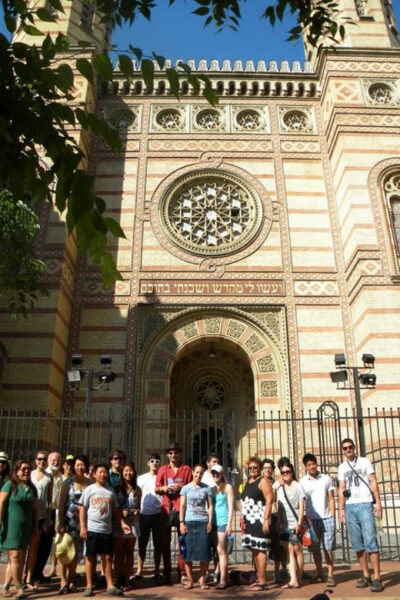
Past and Present of Budapest Jewish District Tour
Read our review →
Budapest Dohany Synagogue & Hungarian Jewish Museum & free extras
Read our review →
Jewish History Guided Walking Tour with Historian
Read our review →Browse the lists this tour appears in