
Reviewed · COMMUNIST HISTORY TOURS
Private Budapest Hammer & Sickle Communist Times Tour
Prague’s grand squares and Old Town streets carry the marks of two very different dictatorships. This walking tour links them through prisons, former party offices, protest sites, and the places where Nazi and Communist power once shaped daily life. Wenceslas Square and National Avenue give the tour its strongest sense of place.
I like two things in particular: the small private format lets your guide adjust the emphasis to your interests, and the best guides bring old photos, family memories, and first-hand experience of Communist-era Prague. I also like the route’s contrast between handsome city squares and grim political stories.
There is one important warning. The information provided calls this a Budapest tour in one place, but the entire route, meeting context, and sightseeing program describe Prague. Confirm the city, meeting point, and exact itinerary before paying. The duration is also described as both three and three and a half hours.
Key points to know before booking
- A Prague route, despite the Budapest title: Every named stop is in Prague, including Wenceslas Square, National Avenue, Republic Square, and Letna Park.
- Strong choice for 20th-century history: The tour covers Nazi occupation, the Prague Uprising, the 1968 Soviet invasion, and the 1989 Velvet Revolution.
- Private group format: Only your group participates, although the general description also refers to groups of up to 15 people.
- Guide quality matters: Honza, Martina, Mike, Mikel, Martin, and Yonas are praised for energy, personal insight, and clear historical explanation. One guide was criticized for a long opening talk and poor organization.
- Expect serious walking: The route includes about two hours of continuous walking, stairs, high curbs, and slippery surfaces.
- Best for older teenagers and adults: The subject is not recommended for children under 14, and the tour runs in all weather.
A tour about power, protest, and memory
This is not a general sightseeing walk with a few historical facts added along the way. The focus is Prague under Nazi occupation and Communist rule, with some attention to the events that led from one system to the next.
You begin in central Prague with an introduction to the city’s 20th-century story. From there, the guide connects buildings and public spaces to real events. A square is not just a square here. It may have been a place of resistance, a stage for political speeches, a target for tanks, or the headquarters of the people controlling the country.
I find that approach useful because Prague’s older architecture can make the recent past feel distant. The tour brings the 1930s, 1940s, 1960s, and 1980s close to the streets beneath your feet.
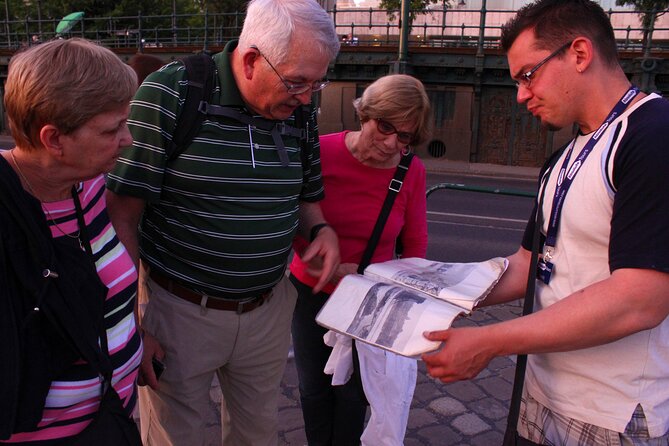
The strongest guides add color without turning the walk into a lecture. Martina, for example, had lived through the Communist period, while another guide had been present during the Velvet Revolution. Mike was praised for explaining what daily life felt like under both Nazi and Communist rule. Several guides also used old photographs and articles on a tablet, a simple but effective way to compare Prague then and now.
Still, the experience depends heavily on the person leading it. One guide reportedly spent an hour and fifteen minutes talking in one spot before the walk really began. Another was difficult to follow because of weak English. A private tour gives you a chance to ask for a change, but it does not guarantee a perfect guide.
More communist-era history walks:
- Budapest: Communist History Tour with House of Terror Option
★ 4.8 · 182 reviews - Communism in Hungary with a Historian
★ 5.0 · 70 reviews - Budapest: 3-Hour Walking Tour About Communism (Small Group)
★ 4.7 · 70 reviews
Bartolomejska Street and the machinery of fear
The route starts around Bartolomejska Street, associated with a former Second World War prison used by secret police to torture prisoners. This is a sobering opening rather than a light introduction to Prague.
The stop helps explain how repression worked. The tour is not limited to famous battles and political speeches. It also deals with imprisonment, interrogation, and the less visible systems used to control people.
You should expect to spend time listening outdoors, with no promise of a long indoor visit. That matters in cold or wet weather. One person found the amount of outdoor explanation uncomfortable on a very cold day and suggested that the guide have an indoor alternative.
The subject also makes this a poor fit for young children. The minimum suggested age is 14, and I would choose it mainly for teenagers and adults who can handle difficult material.
National Avenue and the protest tradition
Next comes National Avenue, the broad thoroughfare dividing Prague’s Old Town and New Town. Its importance comes from two separate periods of protest.
The guide describes student demonstrations against the occupying Nazis in 1939, then moves forward to protests against Communist rule in 1989. That later movement helped bring about the Velvet Revolution, the peaceful political change that ended Communist rule in Czechoslovakia.
This is one of the tour’s most useful stops because it shows that public protest was not a single event. Students, workers, and ordinary citizens returned to Prague’s streets at different points, often at great personal risk.
I like the way this part of the route gives the city a human scale. Instead of treating 1989 as a date in a textbook, you stand on the avenue where people gathered and hear how the location fit into the wider struggle.
The guide may explain the events in a thematic order rather than a strict timeline. One person felt the route would have been clearer if it had followed a more chronological sequence instead of moving from subject to subject around the historic center. If you prefer a tidy sequence of dates, ask your guide at the start to organize the story that way.
Wenceslas Square and the Prague Spring
Wenceslas Square is the emotional center of the walk. It has long been tied to Czech resistance against foreign control, and the tour uses the square to explain both the Prague Spring and the events of 1989.
In 1968, reform-minded Communist leader Alexander Dubcek supported a period of liberalization known as the Prague Spring. Soviet-led forces invaded to crush those reforms. The guide asks you to picture tanks in the square and the public shock that followed.
The story continues into early 1969, when Jan Palach set himself on fire in protest against the occupation and the loss of hope. The supplied information does not promise a dedicated Palach stop, so ask your guide if this subject matters to you.
Wenceslas Square works well as a teaching point because the space is large, public, and politically loaded. You can better understand why it became a place for both state displays and popular resistance.
This is also where you may notice the difference between a strong and weak guide. The best ones make the square feel like a sequence of living scenes, using old images or personal recollections. A less organized guide may simply list events without showing how they connect.
A few more Budapest half-days to weigh up
- Private Budapest TukTuk Tour: Custom Route, Hotel Pickup
★ 5.0 · 1,307 reviews - Budapest Essentials Private Tour Highlights and Hidden Gems
★ 5.0 · 861 reviews - Budapest Private Tuk Tuk Half-Day Tour
★ 5.0 · 606 reviews - Budapest One Way Private Transfer to or from Airport
★ 4.5 · 548 reviews
Republic Square and the 1945 Prague Uprising
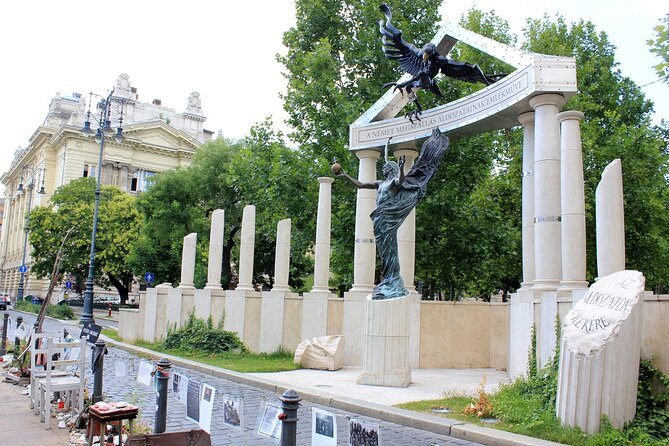
Republic Square takes the story back to the creation of Czechoslovakia in 1918. Its name refers to the proclamation of an independent state, but its later history is far darker.
During the Second World War, Czech resistance workers established secret radio stations that helped spread information. Those broadcasts played a role in the Prague Uprising of 1945, when resistance fighters rose against German control near the end of the war.
The square also brings an important irony into the tour. Three years after the uprising, the Communist Party took power, and the square became associated with that new government. A place named for independence became tied to another system of one-party rule.
That contrast is typical of the walk. Prague’s public spaces changed meaning as power changed hands. I appreciate tours that make you notice those layers instead of stopping at the best-known architectural view.
Old Town, Gottwald’s balcony, and Einstein’s Prague
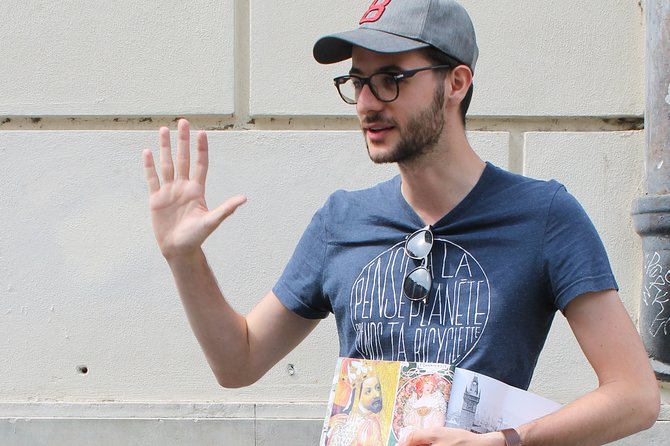
In Old Town, the guide points out the balcony from which Communist leader Klement Gottwald declared the takeover of the government in 1948. This was the moment when Communist power became official after a political crisis, and the balcony served as a stage for the new order.
The building itself may look ordinary beside Prague’s famous churches and medieval façades. That is precisely why the stop works. Political history often happened in places that do not look dramatic today.
The route also reaches the former home of Albert Einstein, who worked at Prague’s Charles University. The guide connects his scientific work and theories to the later development of the atom bomb.
This section adds variety, but it can feel like a detour if your main interest is Nazi occupation and Communist rule. One group found the overall walk extensive and a little long, even though the subject remained interesting. If you want only political history, tell the guide early. Private tours are best when you state your priorities before the route gets underway.
The Jewish quarter, Nazi offices, and Communist surveillance
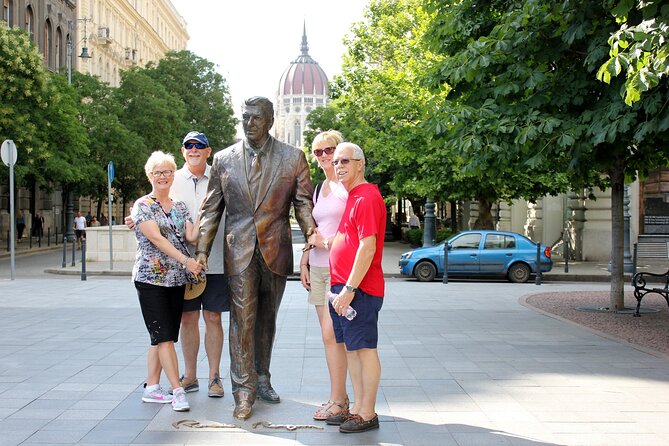
The walk continues toward the old Jewish quarter and the Old Jewish Cemetery. The cemetery is an important reminder that Prague’s wartime story cannot be separated from the persecution of Jewish communities.
The tour also includes views of buildings once used as headquarters by the Nazi SS and the Communist-era KGB. The supplied information also refers to former Gestapo and secret police sites. You should understand that these are primarily exterior viewing points, unless your guide changes the plan.
These locations help you see how different regimes used existing city buildings for administration, surveillance, and force. The architecture may not announce what happened inside, so a good explanation is essential.
Some guides carry supporting material on a tablet, including older photographs and newspaper articles. That can make former headquarters easier to identify and gives you a visual comparison with the present-day streets.
The tour’s connection to Prague’s Jewish history is brief compared with a dedicated Jewish Quarter or Holocaust tour. I would treat it as part of the larger political route, not as a complete introduction to Jewish Prague.
Letna Park and the destroyed Stalin monument
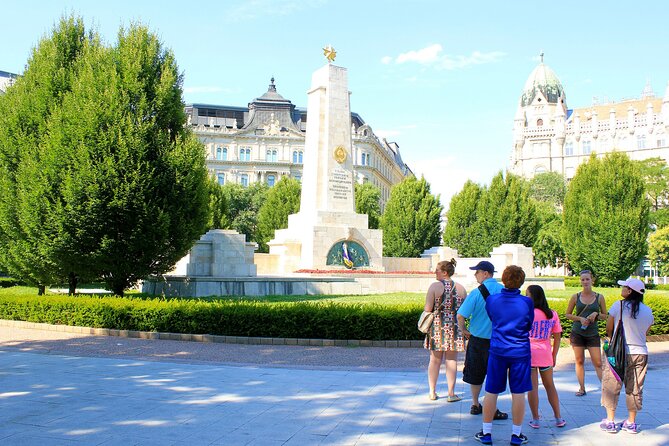
The final major stop is Letna Park by the Vltava River. Here, the guide tells the story of the world’s largest statue of Stalin, built in 1955 and destroyed in 1962.
The monument represented the power and personality cult of the Communist system. Its removal, only a few years later, reflected the changing political mood after Stalin’s death, though it did not mean that Communist rule had ended.
Letna Park provides a useful ending because the story moves from dictatorship to the physical removal of its symbols. The riverside setting also gives you a change of pace after hours among central streets and political buildings.
The tour then ends in central Prague. Since drop-off is not included, you should be ready to continue on foot or make your own way from the ending point. Pickup is offered, but the information does not define the exact pickup area, so confirm it before booking.
How the private format changes the experience
This is described as a private activity, meaning only your group participates. Elsewhere, the tour is described as limited to 15 people and suitable for group discounts. Those details do not fully match, so ask the provider whether your booking is a truly private walk or a small shared group.
In practice, a private format can be valuable here. The subject covers many dates, political movements, and names. You can ask the guide to slow down, explain a point again, or focus more on the Nazi years, the Cold War, or life under Communism.
The strongest guide experiences came from people who adjusted the tour to individual interests. One guide changed the emphasis when the group asked for more about daily life during the Cold War, the Nazi period, the years after Communism, and the fall of the regime. Another guide took a librarian into Prague’s public library because it matched that person’s interest.
That kind of flexibility is hard to get in a large group. It also means you should speak up. Tell the guide if you want more personal stories, more political structure, or a clearer timeline.
Price, timing, and physical effort
At $133.67 per person, this is not a bargain walking tour. The value depends on group size. For one or two people, the cost is substantial. For a private group sharing the fee, the personal attention and ability to shape the route may make more sense.
The stated duration varies between three hours and three and a half hours. Plan for the longer figure, especially if your group asks questions or the guide adds a stop.
A refreshment stop with a beverage is included, along with an English-speaking licensed guide and pickup. Drop-off is not included. Public transportation is nearby, but the walk itself remains the main way you move between sites.
The physical demands deserve careful attention. The tour includes roughly two hours of continuous walking, high curbs, stairs, and slippery surfaces. It is not suitable for people with limited mobility. Wear shoes with a firm grip, and dress for the forecast because the walk operates in all weather.
Cold weather can be a real problem when the guide spends a long time explaining events outdoors. On hot days, the same issue applies in reverse. Ask for shorter stops or a more active route if standing still is uncomfortable.
Who should book this Prague history walk?
I would choose this tour if you already have the main medieval sights covered and want to understand Prague’s recent political past. It suits history-focused adults, older teenagers, students, and anyone interested in the Second World War, Soviet influence, the Cold War, or the Velvet Revolution.
It is especially useful early in a Prague visit because the route helps orient you to the central city. You see Old Town, New Town, the Jewish quarter, Republic Square, Wenceslas Square, and Letna Park while learning why each area matters.
I would hesitate if you want interior visits, a relaxed pace, or a short stroll with only light commentary. Much of the experience takes place outside, and the material is serious.
I would also confirm the guide’s language ability and the exact route. Most guide feedback is strongly positive, with praise for Honza, Martina, Mike, Mikel, Martin, and Yonas. But the few poor experiences show that organization and communication can vary.
Should you book it?
Book this walk if you want Prague explained through occupation, resistance, repression, and political change rather than through castles and royal legends. The most memorable parts are likely to be Wenceslas Square, National Avenue, the former power centers, and the personal perspective of a guide who lived through Communist rule.
The $133.67 price is easiest to justify for a private group that will ask questions and use the guide’s flexibility. Before booking, verify that the activity is in Prague, confirm the meeting and pickup details, ask whether the tour is private or shared, and plan for three and a half hours outside.
If your group dislikes long explanations or has mobility limits, choose another way to study this part of the city. For a serious, street-level look at Prague’s 20th-century struggles, though, this can be a very worthwhile introduction.
FAQ
Is this tour in Budapest or Prague?
The provided tour information names Budapest in the title and location field, but every described stop is in Prague. Confirm the city and meeting point with Absolute Tours before booking.
How long does the tour last?
The duration is described as approximately three hours in one place and three and a half hours in the detailed program. Plan for up to three and a half hours.
Is the tour private?
It is described as a private activity for your group only. The description also refers to small groups limited to 15 people, so confirm the exact format for your booking.
What is included?
The tour includes a licensed English-speaking guide, a refreshment stop with a beverage, and pickup. Drop-off is not included.
Is the tour suitable for children?
Because of the subject matter, the tour is not recommended for children under 14.
Is the walk suitable for people with limited mobility?
No. The walk involves about two hours of continuous walking, high curbs, stairs, and slippery surfaces, so it is unsuitable for people with limited mobility.
Just added around Budapest
- Budapest: Private, Personalized Pub Crawl, 3 drinks included★ 4.5 · 3 reviews
- Private day trip from Budapest to Bratislava, Vienna, and back★ 3.5 · 3 reviews
- Budapest: Private Adventure Sightseeing Bicycle Tour★ 4.5 · 3 reviews
- Private Danube Bend tour – full day★ 4.5 · 3 reviews
- Budapest: Guided City Walking Tour in Buda and Pest★ 5.0 · 3 reviews
- Budapest Old Jewish Quarter History Private Walking Tour★ 5.0 · 3 reviews
- Lake Balaton Full Day Private Wine Tour★ 5.0 · 3 reviews
- Budapest Urban Feast – Food Tour with Wine Tasting & Coffee House★ 4.5 · 3 reviews
Communist History Tours, compared.
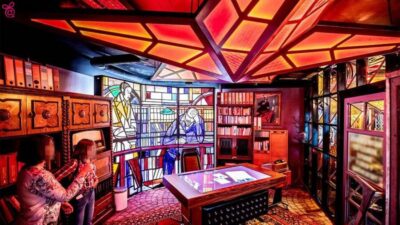
Communist History Tour with House of Terror Option
Read our review →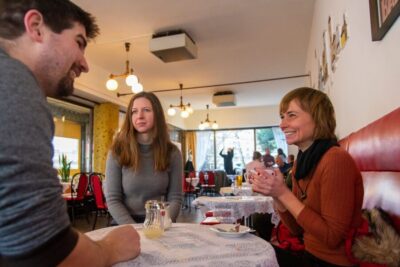
3-Hour Walking Tour About Communism (Small Group)
Read our review →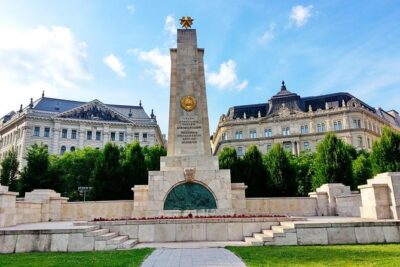
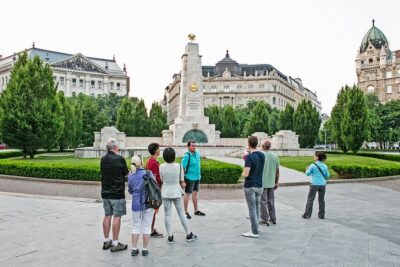
Lives of Hungarians Under Communist and Capitalist system
Read our review →
Communist History Evening Walking Tour of Budapest
Read our review →Browse the lists this tour appears in