Reviewed · PRIVATE
Private Café Wandering: Excursion through Budapest’s Belle Epoque
Budapest’s old cafe culture comes alive on this private walk through grand rooms where writers, artists, politicians, actors, and intellectuals once met. You move from Vörösmarty tér to Andrássy Boulevard, with a tram ride beside the Danube and plenty of local history along the way. The route includes six notable cafe venues, though the tour is described as a visit to five classic cafes because the New York Cafe is primarily a sightseeing stop and Művész is the final place to sit.
I like the private format, which gives you room to ask questions and keeps the pace in your hands. I also like the art historian guide, with Kata receiving especially warm praise for her informative and generous approach. The main consideration is cost: $449.51 covers the whole group of up to 10, but every coffee, cake, and other refreshment comes separately.
Key points at a glance
- Gerbeaud begins the story: Start at Vörösmarty tér in one of Budapest’s grandest and oldest cafe settings.
- Six cafe stops, not just one coffee break: The route links Gerbeaud, Central, Museum, Urania, New York, and Művész.
- An art historian leads the walk: Expect cultural context, not just dates and decorative details.
- A tram ride adds variety: Travel beside the Danube from the first cafe to Central Cafe.
- New York Cafe is a visual high point: See one of Budapest’s most ornate cafe interiors before finishing near the Opera House.
- Budget extra for treats: Refreshments, cakes, and coffees are not included in the tour price.
Why Budapest’s cafe culture deserves three hours
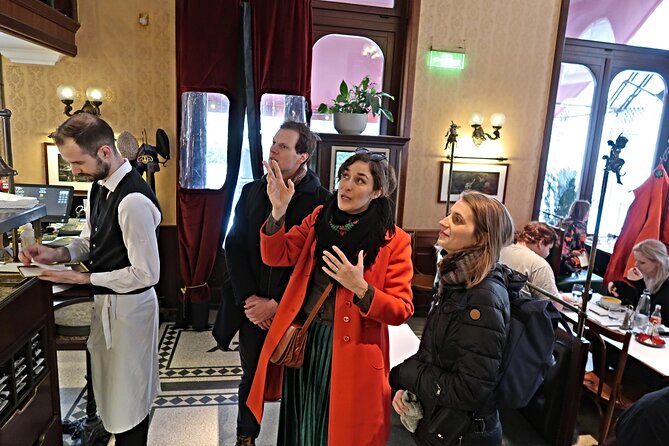
In Budapest, a cafe was once far more than a place to grab a quick drink. During the late 19th and early 20th centuries, cafes served as meeting rooms, offices, reading rooms, debating halls, and social clubs. Writers could spend long hours at a table. Politicians could exchange ideas. Artists and actors could find an audience.
This tour uses that cafe tradition as a way to understand Budapest during the high point of the Habsburg Empire’s economic and cultural life. You are not simply moving from one pretty interior to another. Your guide explains how each cafe functioned and why the setting mattered.
I like this approach because the subject is specific. Instead of trying to cover all of Budapest in three hours, the walk focuses on one cultural habit and follows it across several parts of central Pest. You get architecture, social history, literature, food, public transport, and a little people-watching in one compact outing.
The private setting matters here. With only your own group and the guide, you can ask about a particular writer, building detail, or period of Hungarian history without waiting for a larger group to catch up. The maximum group size is 10, so the price makes the most sense if you are sharing it with family or friends.
A few more Budapest half-days to weigh up
- Private Budapest TukTuk Tour: Custom Route, Hotel Pickup
★ 5.0 · 1,307 reviews - Budapest Essentials Private Tour Highlights and Hidden Gems
★ 5.0 · 861 reviews - Budapest Private Tuk Tuk Half-Day Tour
★ 5.0 · 606 reviews
Starting at Gerbeaud on Vörösmarty tér
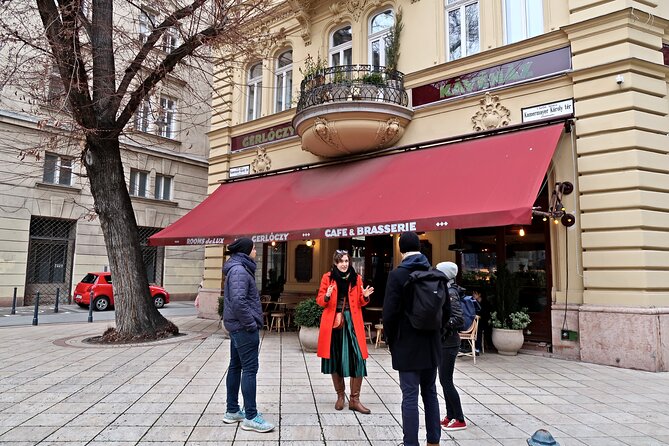
The meeting point is Café Gerbeaud at Vörösmarty tér 7 to 8. Unless hotel pickup has been arranged, you should arrive 15 minutes before the start time. This is a useful place to begin because the square sits in the heart of central Budapest and is easy to connect with by public transportation.
Gerbeaud has more than 100 years of history and served as a central social hub for locals and visitors during the late 19th century. Its interior sets the tone for the outing: elegant, formal, and designed for lingering rather than rushing through a takeaway drink.
Your guide uses Gerbeaud to introduce the atmosphere of Imperial Budapest. Pay attention to how the cafe is presented as a social setting. The point is not only the pastries or decoration. It is the idea that a cafe could act as a public living room for an entire city.
Because Gerbeaud is the starting point, you may want to arrive with time to find the entrance and settle in. The tour price does not include refreshments, so you should not assume that a coffee or cake at every stop is part of the fee. The route offers many chances to order something, but you decide what to buy.
Taking the tram beside the Danube to Central Cafe
From Gerbeaud, the group takes a tram along the Danube to Central Cafe. This short ride breaks up the walking and gives you a quick look at Budapest from street level. It also helps connect the first two venues in a way that feels part of daily city life rather than a private coach excursion.
Central Cafe is presented as one of the clearest examples of what 19th-century cafe culture meant. The setting is dignified, with careful decoration, meals, desserts, and drinks that help recreate the social rituals of the period.
I like the contrast between the ride and the cafe. You leave the ornate starting point, pass through the city by public transport, and then return to a formal interior where the guide explains how people once spent their working and social hours. That change of pace keeps the three-hour walk from feeling like a string of similar rooms.
Keep in mind that the tram is part of the described route, but the tour details do not specify whether a public transport ticket is included. If that matters to your planning, ask the operator before departure. The important practical point is that this is an urban walking tour with a short ride, not a vehicle-based sightseeing trip.
Reading the walls at Museum Cafe
A short walk brings you to Museum Cafe, which has operated since 1885. Its guest book once included members of Parliament, writers, and Hungarian actors. That detail gives the venue a useful connection to the people who shaped public and cultural life in Budapest.
The decoration is a major reason to stop here. The walls are covered with tiles from the Zsolnay porcelain works, one of Hungary’s best-known makers of decorative ceramics. A large 19th-century Venetian mirror adds another distinctive feature.
Here, the guide’s art history background becomes especially useful. The room itself carries part of the story, but the meaning of the tiles, mirror, guest book, and clientele comes through better when someone connects them to the period. You can look at the design as decoration, or you can see it as evidence of how much importance Budapest placed on cafe interiors.
This stop also shows why the tour is more than a dessert crawl. The cafes are treated as cultural spaces, and the objects inside them help explain their role. If you are interested in architecture, decorative arts, or literary history, Museum Cafe may be one of the most rewarding sections of the walk.
Same city, a completely different way to spend an afternoon:
- Budapest: City Highlights Cruise with Welcome Drink
★ 4.6 · 35,610 reviews - Budapest: Unlimited Prosecco, Beer and Aperol Spritz Cruise
★ 4.8 · 25,310 reviews - Budapest: Széchenyi Spa Day Ticket with Optional Upgrades
★ 4.3 · 23,911 reviews - Budapest: Nighttime or Daytime Sightseeing Cruise
★ 4.2 · 21,062 reviews
Urania Cafe and Budapest’s intellectual life
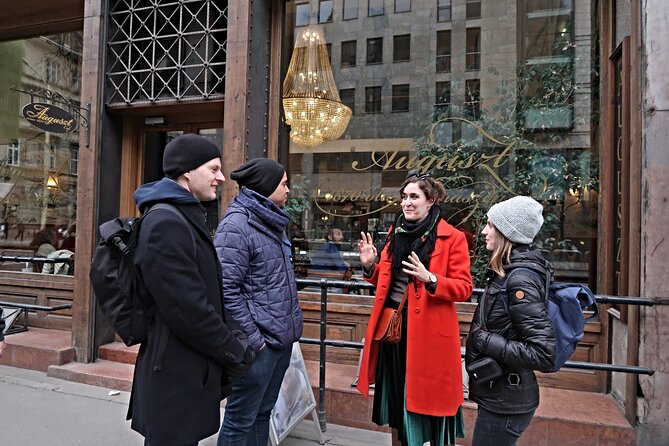
Next comes Urania Cafe on Rákóczi Street. The building houses Budapest’s oldest film theatre, and the venue is linked with lectures by prominent intellectuals before large audiences of Budapest’s cosmopolitan public.
This stop broadens the story. Gerbeaud and Central Cafe show the cafe as a place for conversation, dining, and social ritual. Urania adds public education and film culture. It points to the way cafes could connect with lectures, ideas, and new forms of entertainment.
The stop is also a reminder that Budapest’s Belle Epoque was not only about grand decoration. It was a period when people gathered to exchange ideas and follow new cultural developments. Your guide can explain how Urania fit into that world, making the visit more meaningful than a quick look at the facade.
The route includes several short walks, so comfortable shoes are sensible. The tour lasts about three hours, and you will spend time both outdoors and inside cafes. If you prefer a nonstop indoor activity, this may not be the right choice, but the walking is part of what links the neighborhoods and venues together.
Seeing the New York Cafe on the grand boulevard
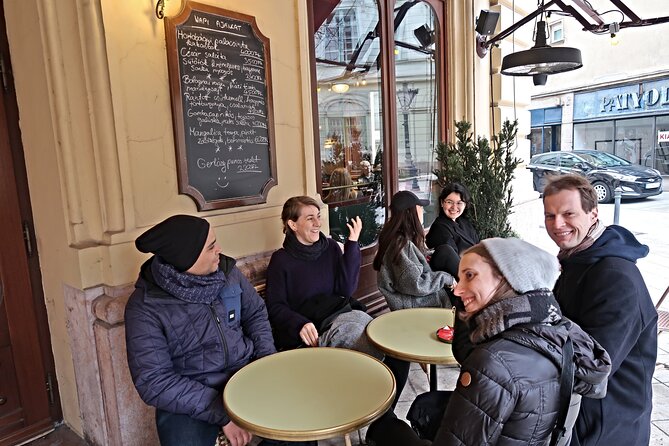
From Urania, you walk toward Blaha Lujza tér along the broad boulevard to the New York Cafe. This is one of the best-known cafe interiors in Budapest and is described as one of the most beautiful cafe houses in the world.
The New York Cafe provides a dramatic visual moment. After the more focused historical details at Museum Cafe and Urania, this venue gives you a chance to appreciate the scale and elegance of Budapest’s cafe tradition in a more theatrical setting.
The route information treats New York Cafe as a sight on the walk rather than promising a full seated meal there. That distinction matters. You should not build your budget or expectations around having a table at every cafe. The final sit-down coffee and cake takes place at Művész Cafe.
The walk toward Blaha Lujza tér also gives your guide room to connect the cafes with the city around them. You are not being moved between isolated attractions. You are following a route through central Pest, with the boulevards and public spaces forming part of the experience.
Finishing at Művész Cafe near the Opera House
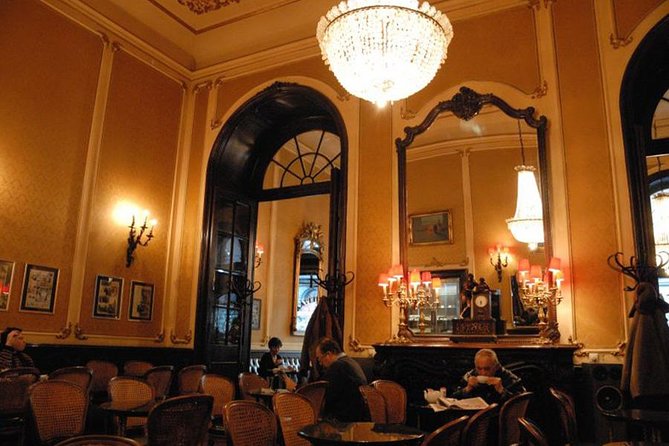
The final stop is Művész Cafe on Andrássy Boulevard, near the Opera House. The venue is associated with Budapest’s theater district, often called Budapest Broadway, and actors and actresses from nearby productions regularly patronize it during rehearsal breaks.
This is a fitting place to end. The tour begins with the historic social world of Gerbeaud and finishes with a cafe still connected to performance and public life. You sit down for coffee and cake, though the cost of those refreshments is not included.
The setting near the Opera House adds a useful final connection. By this point, the cafes have been linked with writers, artists, politicians, intellectuals, filmmakers, and actors. Művész shows how cafe culture can continue as part of a city’s working cultural life.
The chance to sit at the end is welcome after several stops and walks. It also gives you time to ask final questions or compare the different venues. The tour description hopes you might catch sight of local performers, but you should treat that as a possibility, not a promised feature.
What the private guide adds
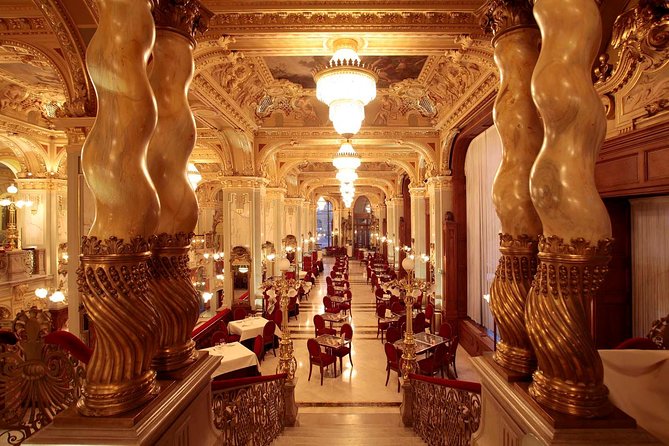
The tour is led by an art historian, and that is an important part of the value. The buildings and interiors can be visited without a guide, but the connection between their decoration and Budapest’s cultural life is harder to grasp on your own.
A guide can point out why Gerbeaud mattered as a social hub, why Central Cafe represents the cafe house tradition so well, and how the guest book at Museum Cafe connects the building to public figures. At Urania, the focus shifts to lectures and film. At Művész, it moves toward the theater world.
One guide named in the available feedback is Kata. She was described as informative and generous with her time, and the tour was appreciated for mixing cafe visits with other Budapest sights. That is useful guidance for setting expectations: this is not a rigid sequence of interiors. You also receive commentary as you move through the city.
Because it is a private tour, you can make the experience more personal by telling the guide what interests you. The information provided does not promise a particular guide for every departure, so Kata should not be assumed unless your booking confirms her name.
Price, group size, and what you really pay for
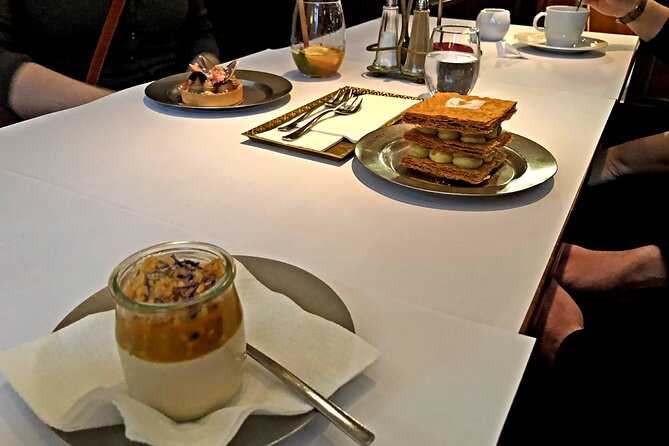
The cost is $449.51 per group of up to 10 people. That price can offer fair value for a family or group of friends because it does not rise with each member, at least within the stated limit. For two people, the per-person cost is much higher, so the value depends heavily on your group size and interest in the subject.
The fee covers a three-hour private walk with an art historian through Budapest’s historic cafe houses. It does not cover coffees, cakes, meals, or other refreshments selected at the cafes.
I would compare this price with the cost of a standard city walk, but the format is different. You are paying for a focused cultural theme, a private guide, several historic venues, and a route that includes public transport and neighborhood walking. If cafe culture is low on your list, the price may feel steep. If you enjoy architecture, literature, social history, and food traditions, the concentration of material makes more sense.
Plan a separate refreshment budget. You do not need to order at every stop, and the tour details do not require it, but the experience is designed around cafe interiors and rituals. Ordering something at the final Művész Cafe stop would fit the spirit of the route, provided you pay for it yourself.
Who will get the most from this walk
I would recommend this experience to anyone who wants a focused way to understand Budapest’s Belle Epoque. It suits adults and older children who enjoy history, architecture, literature, design, or the small details behind famous buildings.
It is also a good choice for repeat visitors. If you have already seen the main sights, the cafes offer a different way to read the city. You move through familiar central areas while learning how people used these rooms in another era.
The private format works well for groups with mixed interests. One person can ask about Hungarian writers, another about Zsolnay tiles, and another about the Opera House district. A large group would make that kind of conversation harder.
Most travelers can participate, and the tour is near public transportation. Still, you should be comfortable with walking, several short stretches between venues, and time spent standing or moving through busy central streets. The precise accessibility details are not provided, so anyone with mobility concerns should check directly before booking.
Practical details before you book
The experience is offered in English and lasts about three hours. It begins at Vörösmarty tér, with the default meeting point at Café Gerbeaud, Vörösmarty tér 7 to 8, 1051 Budapest.
Hotel pickup is offered if arranged. Without that arrangement, arrive 15 minutes before the start time. The tour ends in Budapest near Művész Cafe and Andrássy Boulevard, rather than returning to the original meeting point.
You receive booking confirmation at the time of reservation. Free cancellation is available if you cancel at least 24 hours before the local start time. Cancellations or changes made within 24 hours are not accepted for a refund.
The tour operates privately, with only your group and the guide. That makes it easier to tailor questions and keep the outing comfortable, but it also means the group price is designed to be shared. If you are traveling alone or as a couple, consider whether the subject is important enough to justify the higher individual cost.
Should you book the Budapest cafe walk?
Book it if you want Budapest explained through its cafes rather than through a checklist of major monuments. The route has a clear theme, several distinctive interiors, an art historian guide, and a pleasant mix of walking, tram travel, cultural commentary, and time to sit down.
I especially like the combination of Museum Cafe’s Zsolnay tiles, Urania’s link with lectures and film, New York Cafe’s grand interior, and Művész Cafe’s connection with the Opera House district. The stops do not all serve the same purpose, which keeps the story moving.
Skip it if you want a food tour with included tastings, or if you prefer a broad overview of Budapest’s top sights. Refreshments cost extra, and the three-hour route is built around history and cultural context rather than a large meal.
For a group of several people who enjoy old cafes, design, and city stories, this is a thoughtful and distinctive way to spend part of a Budapest day. For two people on a tight budget, I would weigh the private-tour price carefully before booking.
FAQ
How long does the Budapest cafe tour last?
The private walking tour lasts approximately three hours.
Where does the tour start?
It starts at Café Gerbeaud, Vörösmarty tér 7 to 8, 1051 Budapest. Unless hotel pickup has been arranged, meet the guide there 15 minutes before the start time.
Which cafes are included?
The route includes Gerbeaud, Central Cafe, Museum Cafe, Urania Cafe, New York Cafe, and Művész Cafe. New York Cafe is visited as a sight, and the final coffee and cake stop is at Művész Cafe.
Are coffee, cake, and other refreshments included?
No. The tour price does not include refreshments, cakes, coffees, or meals selected at the cafes.
How much does the private tour cost?
The listed price is $449.51 per group of up to 10 people.
Is the tour offered in English?
Yes. The experience is offered in English.
Can I cancel for a full refund?
Yes, if you cancel at least 24 hours before the experience start time. Cancellations or changes made less than 24 hours before the start are not accepted for a refund.
Just added around Budapest
- Budapest: Private, Personalized Pub Crawl, 3 drinks included★ 4.5 · 3 reviews
- Private day trip from Budapest to Bratislava, Vienna, and back★ 3.5 · 3 reviews
- Budapest: Private Adventure Sightseeing Bicycle Tour★ 4.5 · 3 reviews
- Private Danube Bend tour – full day★ 4.5 · 3 reviews
- Budapest: Guided City Walking Tour in Buda and Pest★ 5.0 · 3 reviews
- Budapest Old Jewish Quarter History Private Walking Tour★ 5.0 · 3 reviews
- Lake Balaton Full Day Private Wine Tour★ 5.0 · 3 reviews
- Budapest Urban Feast – Food Tour with Wine Tasting & Coffee House★ 4.5 · 3 reviews
Private, compared.
Private Budapest TukTuk Tour: Custom Route, Hotel Pickup
Read our review →
Budapest Essentials Private Tour Highlights and Hidden Gems
Read our review →
Budapest One Way Private Transfer to or from Airport
Read our review →
Budapest Private Luxury Sightseeing Tour with Guide and Transport
Read our review →
Private Budapest City tour with Classic Russian Jeep or G-Wagon!
Read our review →
Budapest Private Full Day City Sightseeing Tour Walking or by Car
Read our review →