
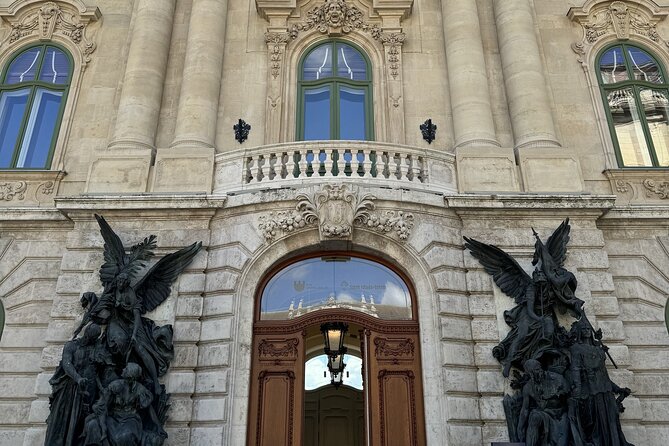
Reviewed · BUDA CASTLE DISTRICT TOURS
Gems of the Budapest Castle District Walking Tour
Budapest’s Castle District packs royal courts, medieval ruins, Ottoman-era stories, wartime scars, and sweeping views of Pest into one hilltop walk. This tour follows a broad route from the Holy Trinity Statue to Castle Garden Bazaar, with guide Antel bringing clear English, humor, and useful city advice to the walk.
I like the huge range of sights covered in about two hours, from Matthias Church and Fisherman’s Bastion to the Royal Riding Hall and the castle gardens. I also like the frequent short stops, which give you time to take photos instead of rushing past every statue.
The main consideration is pace. You cover 20 stops in roughly 2 hours and 10 minutes, so this is a fast overview rather than a slow architectural study. The group can reach up to 45 people, and there is plenty of walking on Castle Hill.
Key points at a glance
- A low-cost introduction: At $3.61 per person, the tour offers a striking amount of guided sightseeing for the price.
- A long, varied route: You pass churches, royal monuments, ruins, courtyards, gardens, and viewpoints.
- Strong guide appeal: Antel is praised for precise English, humor, clear explanations, and practical Budapest suggestions.
- Free sightseeing stops: The listed stops have no admission charge, though the tour price does not include tips or gratuities.
- Best photo stop: Fisherman’s Bastion brings wide Pest views and time to explore its statues.
- A useful final position: The walk ends at Castle Garden Bazaar, below the castle hill and near the riverfront side of the district.
A smart way to read Budapest’s Castle Hill
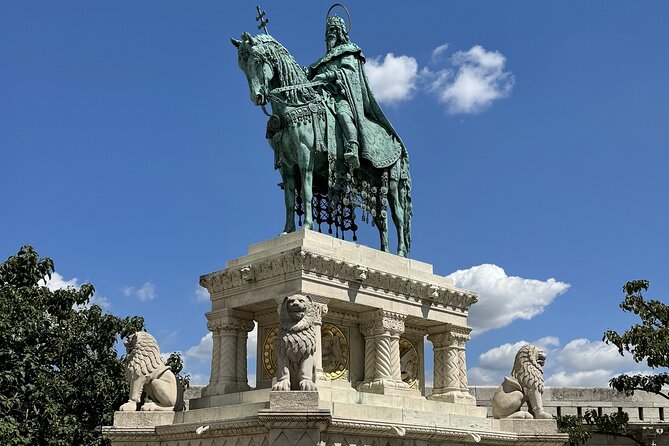
Castle Hill can feel confusing at first. Its streets curve around old walls, courtyards open without much warning, and the most famous sights are mixed with statues and ruins that make little sense without context.
This walk gives you a thread to follow. You begin around the Holy Trinity Statue and Matthias Church, move toward Fisherman’s Bastion and the northern promenade, then cross through the old castle area before descending toward Castle Garden Bazaar.
That route matters. You are not simply being taken to the two postcard sights. You also get the lesser-known monuments, wartime reminders, government buildings, and royal rebuilding projects that explain why the district looks as it does today.
The tour begins at 3 p.m. That timing can work well if you want to spend the morning in Pest, visit the Parliament area, or take a slower lunch before heading up the hill. It also gives you the late-day portion of Budapest, when the views toward Pest can be especially appealing, though the exact light depends on the season.
More ways to see the Castle District:
- Budapest: Buda Castle Cave Tour
★ 4.7 · 5,677 reviews - Budapest: Buda Castle District Vampires and Myths Night Tour
★ 4.6 · 3,830 reviews - Budapest: Buda Castle Walk with Saint Stephen’s Hall
★ 4.5 · 3,012 reviews
Holy Trinity Square and Matthias Church
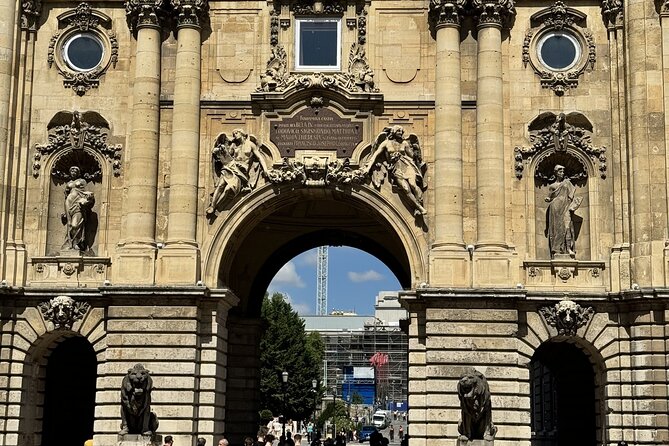
The first stop is the Holy Trinity Statue, a short introduction to the column’s construction and the symbolism of its figures. This is a quick five-minute stop, so expect the guide to explain the main idea rather than provide a long art lecture.
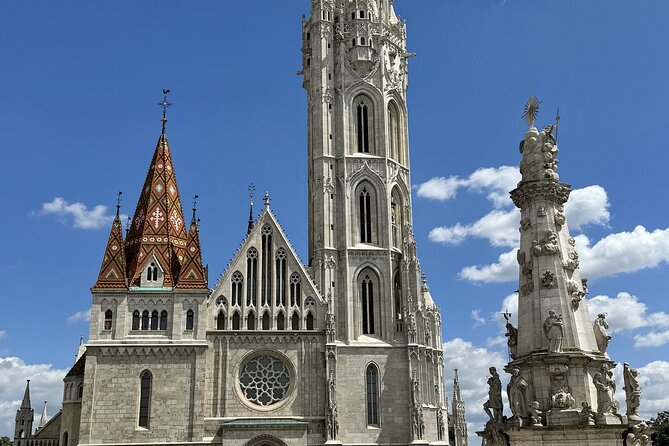
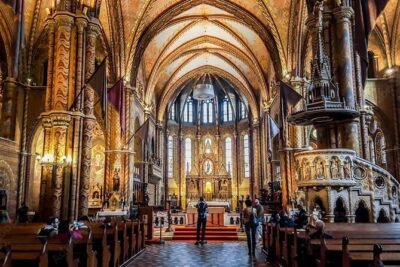
From there, the route reaches Matthias Church. The guide covers the church’s foundation and points out architectural details. Even if you have already seen photographs of its patterned roof and ornate exterior, a few minutes of explanation can help you read the building instead of simply photographing it.
The short timing is both useful and limiting. It keeps the tour moving, but it does not allow for a full church visit or a detailed interior study. If Matthias Church is a main reason for your visit, plan separate time to explore it beyond the walk.
Fisherman’s Bastion and the best view toward Pest
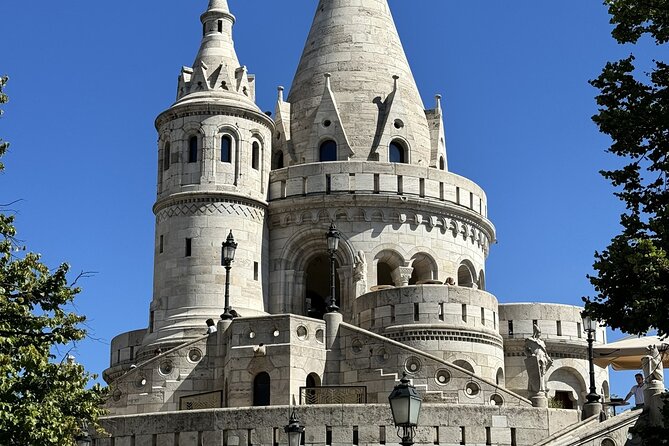
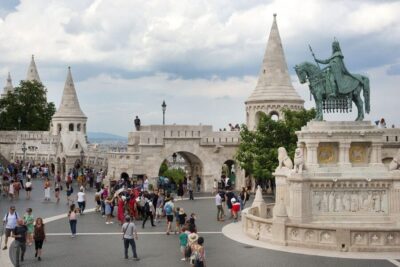
Fisherman’s Bastion gets the longest stop, about 20 minutes, and that is sensible. Its towers, stairways, arches, and terraces provide the tour’s clearest photo opportunity.
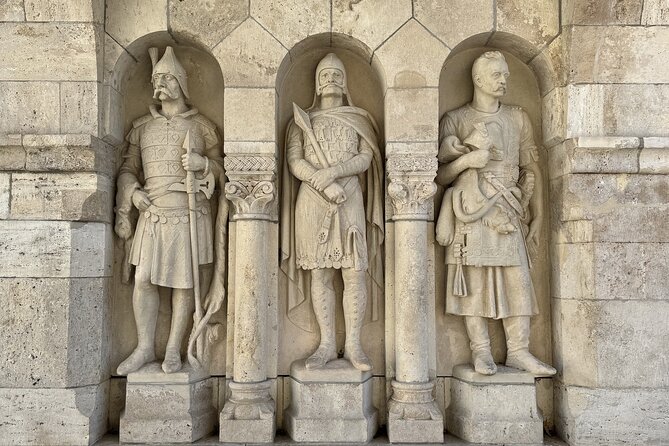
You hear about the unusual statues, the double cross and its connection with Hungarian identity, and local legends tied to the site. The guide also gives you time to look around and take photos of Pest from above.
I especially like that this stop is not treated as a quick photo dash. The bastion can look like a decorative set if you do not know what you are seeing. Stories about its symbols and statues give the place more meaning, while the open views help you understand Buda’s position above the Danube.
You should still keep the timing in mind. Twenty minutes goes quickly here, especially if you want both close views of the stonework and wide views across Pest. Have your camera ready before the stop begins.
Statues, archives, and the old town’s surviving fragments
The tour then moves through a series of compact stops. At the Statue of Pope Innocent XI, the guide connects nearby monuments with figures such as Pope Sylvester II and King Matthias. The route also touches on the claim that the district contains Hungary’s oldest building, giving you a sense of how much time is layered into this small area.
At the National Archives of Hungary, the focus shifts to architecture, Vienna Gate, the golden signatures along Uri Street, and statues nearby. These details reward close attention. They are easy to miss if you walk through the district alone, especially when your eyes are fixed on the main church and bastion.
The Church of Saint Mary Magdalene brings a sharper reminder of destruction. The stop includes the monument connected with the coronation mantle of Hungarian kings and the ruins left by World War II.
That contrast is one of the tour’s strengths. You move from grand religious and royal symbols to damaged stone and incomplete structures. Budapest’s Castle District is not an untouched medieval quarter, and the ruins help explain the cost of war and later rebuilding.
More walking tours in Budapest:
- Big Bus Budapest Hop-On Hop-Off Bus and Walking Tour
★ 3.5 · 2,206 reviews - Budapest: Buda Castle District Walking Tour
★ 4.6 · 2,108 reviews - Budapest City Landmarks Walking Tour in 2 Hours
★ 5.0 · 2,048 reviews - 3-Hour Orientation Walking Tour of Buda and Pest
★ 4.8 · 1,834 reviews
The promenade, cannons, and the siege of Budapest
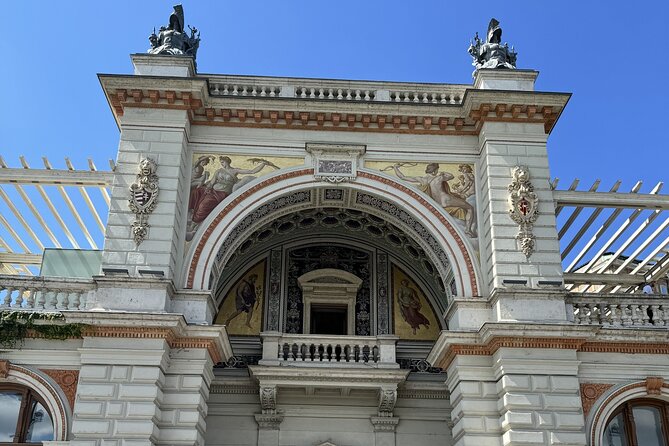
At the Arpad Toth Promenade, you get around 10 minutes for the Buda Hills, a row of cannons, the Székely Knight statue, and discussion of the first flag raised after World War II. The guide also covers the siege of Budapest and the wider wartime story.
This is a good place to pause and let the district breathe. The early stops are tightly packed around major buildings, while the promenade opens the view and gives you a clearer sense of the surrounding hills.
The cannon row and wartime details are especially useful if you want more than a royal postcard version of Buda. The district has changed hands, suffered damage, and been rebuilt more than once. You can see some of that story in the objects and broken remains around the walk.
The guide allows a short break for pictures at several points. Still, this is not a leisurely promenade walk. You should wear comfortable shoes and expect to stay on your feet for most of the tour.
Hadik, the Labyrinth, and stories beneath the hill
The mounted statue of András Hadik introduces one of Hungary’s best-known knights. The stop also includes local customs and the oldest Hungarian confectionery, adding a touch of everyday life to the military and royal stories.
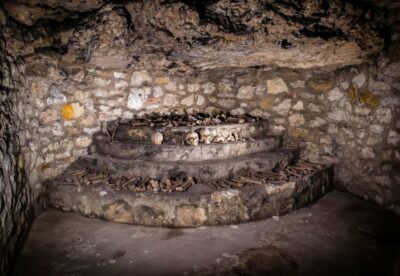
The Labyrinth follows with a different mood. The route covers the natural cave system, its use as a dungeon, and the story of Dracula, or Vlad the Impaler. This is one of the more unusual subjects on the walk because it shifts from open squares and viewpoints to the underground world beneath Castle Hill.
The listed stop lasts about 10 minutes. That is enough for an introduction, but not a long underground visit. You should also note that the information provided lists admission as free for each stop, including the Labyrinth. The tour itself includes a live guide, while tips and gratuities are not included.
The Dracula connection is the sort of story that can make the district memorable, but it is best treated as part of the area’s legends and historical associations rather than the sole reason to visit. The guide’s role here is to connect the cave to the hill’s past.
Independence, Houdini, and the modern political quarter
At the Statue of the Independence War, the guide explains the Hungarian Revolution of 1848 and the symbols built into the monument. The nearby House of Houdini adds a lighter cultural note to the stop.
You then walk along Szent György Street, where the offices of the president and prime minister sit among medieval castle ruins. The guide points out secret stories and explains how official modern buildings share space with remnants of the older royal center.
This section gives the tour a useful political dimension. Budapest’s Castle District is not only an old monument zone. It remains an important civic area, and the mix of government offices, ruins, statues, and reconstructed buildings makes the setting more layered than a simple historic quarter.
The stop at Szent György Street lasts about five minutes, so you will get highlights rather than a full account of Hungary’s political system. That is appropriate for a walking tour covering so much ground.
Funicular, zero kilometer, and the Turul bird
Near the Buda Hill Funicular, the guide discusses the second-oldest funicular, the Zero Kilometer Stone, and Hungary’s oldest bridge. These subjects help place the castle in relation to the city below.
The funicular is a practical transport link, but on this tour it is mainly a landmark and a chance to understand how Buda connects with the lower city. The Zero Kilometer Stone is another small object with outsized importance, marking the point from which distances are measured in Hungary.
The Turul Bird Statue brings national mythology into the route. You learn about Hungary’s national bird and the story connected with the naming of the Hungarians.
This can be a dense section, since several major ideas arrive in quick succession. I would listen for the broad connections rather than worry about memorizing every date or name. The value is seeing how national symbols appear throughout the castle area.
King Matthias and the Lions Court
The Fountain of King Matthias is presented as one of Budapest’s prettiest fountains, with a romantic tragedy attached to its figures. Five minutes is enough to hear the central story and study the sculpture, though you may want extra time later if you enjoy details in historic fountains.
The route then enters the Lions Court of Buda Castle. Here the focus is the castle courtyard, mythical figures on the facade, and local customs. This is a strong place to look up and inspect the decorative stonework.
The castle complex has a grand scale, but the short stop keeps the visit from becoming a long architectural lecture. You get the visual essentials, then continue toward the royal buildings and garden.
I like this part because it balances a famous fountain with a broader castle setting. You get a personal story at the sculpture, then a wider look at the royal court around it.
Royal Riding Hall and Prince Eugene’s statue
The Royal Riding Hall is a brief two-minute stop covering the Hungarian royal stable and local traditions. Since the visit is so short, expect an exterior explanation and a quick look rather than a full tour of the building.
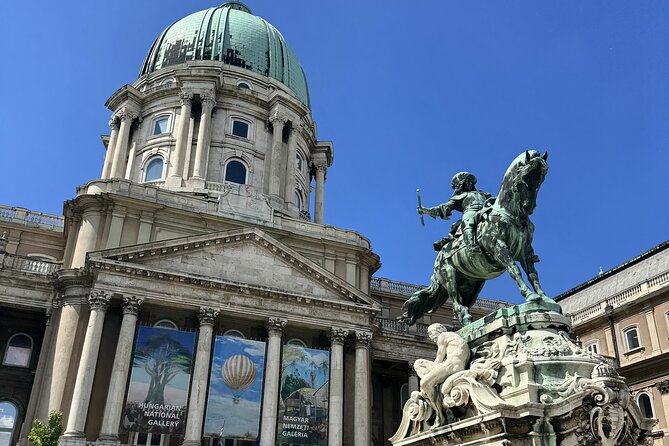
Next comes Prince Eugene of Savoy’s equestrian statue, described as the largest statue in the Castle District. The guide explains his role in liberating Hungary from the Ottomans and adds a few fun facts.
The statue gives you another view of the district’s military story. Earlier, the tour dealt with cannons, the siege of Budapest, and independence. Here, the focus shifts to the wars that shaped Hungary before the modern era.
This is also a reminder that the castle district is full of monuments to military figures. If you prefer architecture alone, the number of statues may feel high. If you enjoy the way public monuments tell political stories, you will find plenty to examine.
S. Maria Mater Dei and Castle Garden
The S. Maria Mater Dei statue shows the Virgin Mary with the infant Jesus. The guide also connects Budapest’s bridges with Hungarian monarchs, tying the hilltop monument to the city below.
The final outdoor portion reaches Castle Garden and includes the garden, a spiral-staircase tower, and the Triton fountain. These are quieter details than Matthias Church or Fisherman’s Bastion, but they help round out the route.
You finish at Castle Garden Bazaar, also called Várkert Bazár, at Ybl Miklós tér. The meeting point is beside the castle garden, at the foot of Castle Hill. That ending is practical if you want to continue near the river or explore the garden area after the guide leaves.
The Bazaar itself receives a five-minute stop focused on its architecture and facade statues. It is a fitting endpoint because the tour has moved from the hilltop’s medieval and royal core down toward a more open city connection.
What the $3.61 price really offers
At $3.61 per person, this is unusually inexpensive for a two-hour guided walk. The value comes from the amount of orientation you receive, not from included attraction entry, food, transport, or extras.
All listed stops are marked with free admission, and the package includes a live English-speaking guide. Tips and gratuities are separate. In practical terms, you are paying for the guide’s route planning, stories, historical links, and help finding details you could easily miss.
The price also makes the tour a low-risk choice for a first look at Castle Hill. You can learn which places deserve a return visit, then spend more time later at Matthias Church, Fisherman’s Bastion, the Labyrinth, or the castle grounds.
The tradeoff is group size. Up to 45 people can join, which may make it harder to hear or move quickly through narrow spots. The guide’s clear English and presentation style are important here. Antel receives especially strong praise for both, along with humor and recommendations for other parts of Budapest.
Who should book this Castle District walk
I would recommend this tour if you want a fast, story-led introduction to Buda and prefer a guide who connects statues, ruins, churches, and legends.
It suits you especially well if:
- You have only a short time in Budapest.
- You want a long list of sights without paying separate entry fees.
- You like history mixed with legends and local details.
- You want photo breaks at major viewpoints.
- You prefer an English walking tour with a clear meeting point and endpoint.
- You want practical suggestions for other parts of the city.
It may be less suitable if you want to enter every major building, spend a long time taking photographs, or move at a slow pace. The itinerary is ambitious, and several stops last only five minutes.
Most people can participate, service animals are allowed, and the route is near public transportation. The tour requires good weather. If poor weather cancels it, you are offered another date or a full refund. You can cancel for a full refund up to 24 hours before the 3 p.m. start time, but late cancellations and changes are not accepted.
Should you book it?
Book this walk if you want maximum Castle District coverage for very little money. Its best features are the wide route, the repeated photo pauses, the strong English presentation associated with Antel, and the mix of famous sights with small statues, ruins, and local stories.
Skip it if your priority is an in-depth visit inside Matthias Church or a slow exploration of the castle complex. For everyone else, this is a practical first pass through Budapest’s most story-packed hill, followed by the freedom to return to the places that caught your eye.
FAQ
Where does the tour begin?
The tour begins at the Holy Trinity Statue on Szentháromság utca in Budapest’s Castle District.
Where does the tour end?
It ends at Castle Garden Bazaar, at Ybl Miklós tér 2 to 6, beside the castle garden at the foot of Castle Hill.
What time does the tour start?
The tour starts at 3 p.m.
How long does the walking tour last?
The tour lasts approximately 2 hours and 10 minutes.
What language is the tour offered in?
The tour is offered in English and includes a live guide.
What is included in the price?
The price includes the live guide. Tips and gratuities are not included.
How large can the group be?
The maximum group size is 45 people.
Can I cancel for a full refund?
Yes. You can cancel at least 24 hours before the experience start time for a full refund. Cancellations or changes made less than 24 hours before the start time are not accepted.
Just added around Budapest
- Budapest: Private, Personalized Pub Crawl, 3 drinks included★ 4.5 · 3 reviews
- Private day trip from Budapest to Bratislava, Vienna, and back★ 3.5 · 3 reviews
- Budapest: Private Adventure Sightseeing Bicycle Tour★ 4.5 · 3 reviews
- Private Danube Bend tour – full day★ 4.5 · 3 reviews
- Budapest: Guided City Walking Tour in Buda and Pest★ 5.0 · 3 reviews
- Budapest Old Jewish Quarter History Private Walking Tour★ 5.0 · 3 reviews
- Lake Balaton Full Day Private Wine Tour★ 5.0 · 3 reviews
- Budapest Urban Feast – Food Tour with Wine Tasting & Coffee House★ 4.5 · 3 reviews
Buda Castle District Tours, compared.

Buda Castle District Vampires and Myths Night Tour
Read our review →

Buda Castle District Dark History, Legends and Vampire Night Tour
Read our review →
Buda Castle District Walking Tour with a Historian
Read our review →
Browse the lists this tour appears in