
Reviewed · CYCLING TOURS
Budapest: Guided Downtown Electric Bike Tour
Budapest is spread across two sides of the Danube, with broad boulevards, riverfront roads, and a serious hill between the flat Pest side and Buda’s castle district. This 3.5-hour e-bike tour gives you a fast, useful look at the city, from Andrássy Avenue and Heroes’ Square to Parliament, Castle Hill, and the Central Market Hall.
I like two things in particular: the bikes make the climb to Castle Hill far less tiring, and the route covers enough ground to help you plan the rest of your stay. Guides including Oliver, Karol, Katalin, Thomas, Balint, and Katy are known for clear storytelling, humor, and personal insight into Budapest.
The main consideration is pace. You’ll stop for photos and explanations, but you will not go inside the sights, and three and a half hours on a bicycle can feel long in poor weather. You must also be comfortable riding in a city and meet the tour’s height and weight limits.
Key points to know before booking
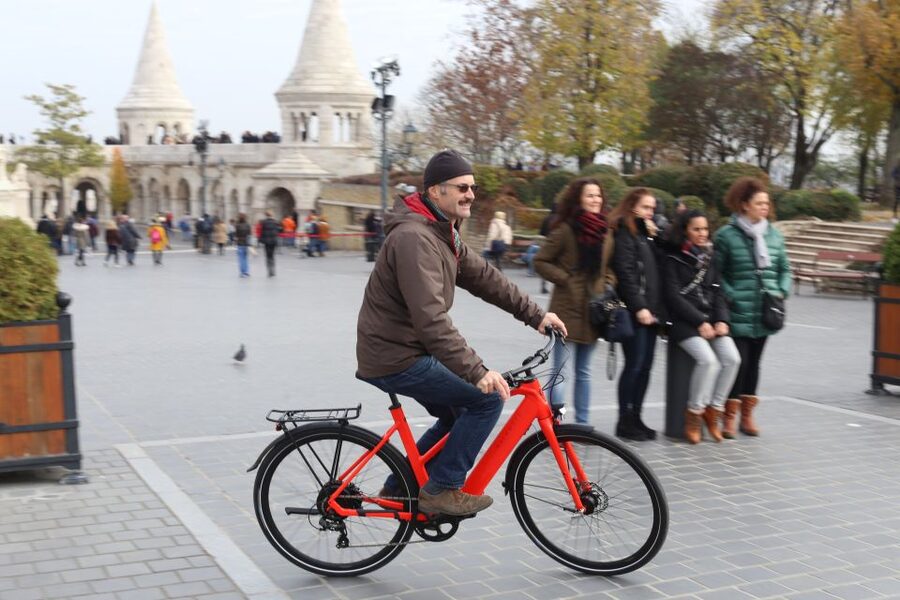
- Castle Hill without the struggle: Electric assistance makes the uphill ride to Matthias Church and Fisherman’s Bastion manageable, even if you are not a strong cyclist.
- A wide city overview: The route takes in Andrássy Avenue, City Park, Parliament, the Danube, Buda Castle Hill, Gellért Hill, the market hall, the museum, and the Jewish Quarter.
- Small groups: The group is limited to 10 participants, which gives the guide room to answer questions and adjust the pace.
- Local storytelling: Guides such as Oliver, Karol, Thomas, Katalin, and Balint explain Budapest’s politics, architecture, Jewish heritage, thermal baths, and wartime past.
- Easy central meeting point: Bike & Relax is near Madách tér, Gozsdu udvar, and Deák Ferenc tér, with several metro lines and the 100E airport bus nearby.
- A useful first-day activity: You get a strong sense of where the main sights are, then can return to the places that deserve a longer visit.
Why an e-bike is the right tool for Budapest
This is not a motorbike ride. You still pedal, but the electric system helps when the road rises or when the group needs to cover a lot of ground. That distinction matters if you expect to sit back without effort. You need to keep pedaling, though the assistance can make the work surprisingly light.
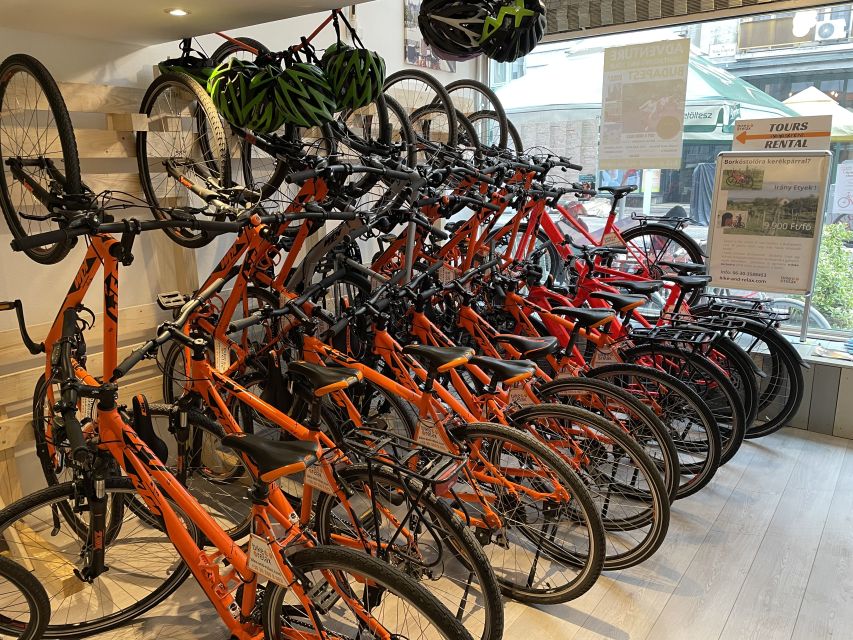
The tour uses wooden-framed my-esel bikes or Kalkhoff Berleen e-bikes. The equipment has received strong marks for comfort, handling, and condition. One rider found the seat less comfortable than the rest of the bike, so you may want to wear practical clothing and avoid expecting a plush saddle.
The electric support matters most on Castle Hill. The ride from the Chain Bridge up toward the castle district is the one part of this route that could turn a sightseeing outing into a workout. With the motor helping, riders with different fitness levels can stay together. You still need basic city-cycling experience, and the tour is not suitable for someone who cannot ride a bicycle.
Helmets are available but optional. The bikes have open chains, so keep loose clothing clear and wear clothes you do not mind getting marked. Comfortable shoes are a good idea. Large bags and luggage are not allowed.
A few more Budapest half-days to weigh up
- Budapest: Grand Sightseeing Bike Tour
★ 4.8 · 984 reviews - Budapest Highlights Bike Tour
★ 5.0 · 770 reviews - Budapest: Guided City Discovery Bike Tour
★ 4.7 · 702 reviews
Starting near Gozsdu udvar and reaching Andrássy Avenue
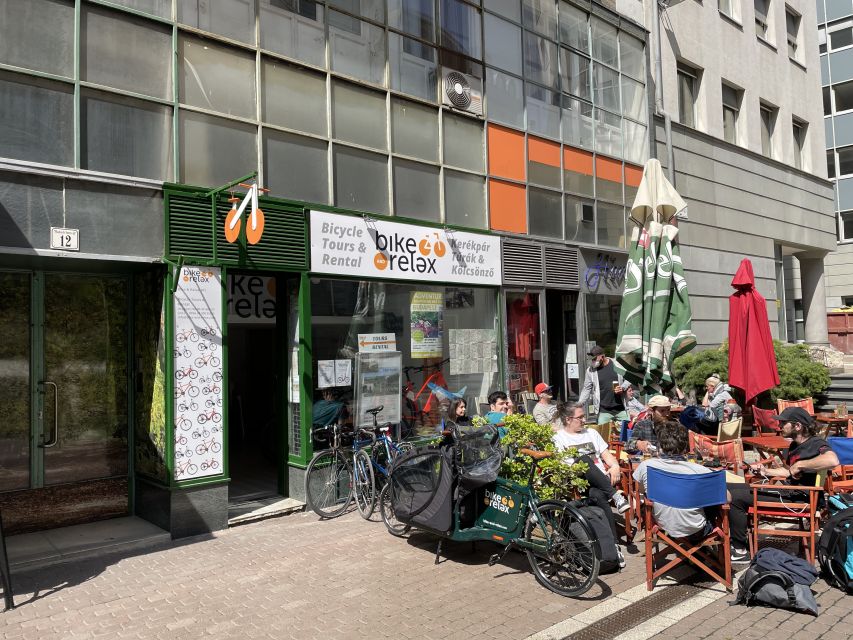
Meet at Bike & Relax in the center of the Jewish district. The shop connects Madách tér with the Gozsdu udvar court and sits beside Cafe Hivatal. Deák Ferenc tér is the nearest major transport point, served by the M1, M2, and M3 metro lines, trams 47, 48, and 49, plus airport bus 100E.
The route soon reaches Andrássy Avenue, Budapest’s grand ceremonial boulevard. It is one of the best places to understand how the city presents itself: elegant buildings, cultural institutions, and a long axis leading toward Heroes’ Square.
You pass the Hungarian State Opera House and the House of Terror. The Opera House represents Budapest’s musical and imperial-era polish. The House of Terror deals with the dictatorships that shaped Hungary in the 20th century, so it is a useful reminder that the city’s beauty sits alongside difficult political stories.
The guide provides the context while you ride, then stops at notable points for photos. Because you are outside, you get an overview rather than a museum visit. Plan a separate visit to the House of Terror or Opera House if you want interiors and exhibits.
Heroes’ Square and the unusual castle in City Park
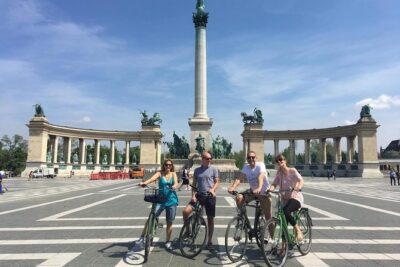
At the far end of Andrássy Avenue, Heroes’ Square opens into a broad monument-lined space devoted to major figures from Hungarian history. It is one of Budapest’s essential photo stops and gives you a quick introduction to the national story before the tour moves into City Park.
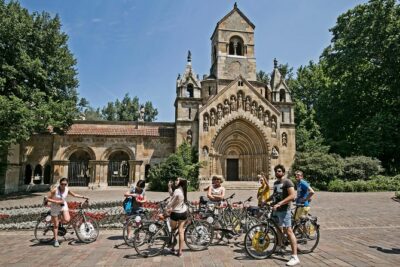
City Park offers a change of mood. The roads and paths feel less formal than Andrássy Avenue, and the tour reaches Vajdahunyad Castle, the striking fake castle built as an architectural showcase. Its design borrows from several parts of historic Hungary, making it fun to look at even if you do not know the background.
Nearby is Széchenyi Thermal Bath, the city’s largest and most popular thermal bath complex. You only see it from outside on this ride, but the stop helps you understand why bathing is such a central part of Budapest’s culture. If a soak is on your list, mark this area for another outing.
The City Park section is one reason the bike format works well. A walking tour from the Jewish district would spend much more time getting here and back. By bicycle, you can connect the boulevard, square, castle, and bathhouse in one morning or afternoon.
From Liszt Ferenc to the Basilica and Liberty Square
The route turns back toward central Budapest, passing the Liszt Ferenc Academy of Music and returning through areas near the Jewish Quarter. Your guide links music, architecture, religion, and daily city life rather than treating each sight as an isolated stop.
St. Stephen’s Basilica is one of the city’s dominant landmarks and the largest church in Budapest. Its dome and broad frontage are easy to appreciate from the streets around it. Again, this is an exterior visit, so set aside time later if you want to see the interior.
Liberty Square is a more politically charged stop. The square has a bloody past, and its monuments reflect disputes over how Hungary remembers the Second World War and the Holocaust. The contested Holocaust memorial here is not a simple photo backdrop. A good guide can explain why it provokes strong reactions and how public memory continues to shape the city.
This is where the tour’s storytelling matters most. You are not only ticking off buildings. You are getting a short lesson in how Budapest has dealt with empire, dictatorship, war, and national identity.
Same city, a completely different way to spend an afternoon:
- Budapest: City Highlights Cruise with Welcome Drink
★ 4.6 · 35,610 reviews - Budapest: Unlimited Prosecco, Beer and Aperol Spritz Cruise
★ 4.8 · 25,310 reviews - Budapest: Széchenyi Spa Day Ticket with Optional Upgrades
★ 4.3 · 23,911 reviews - Budapest: Nighttime or Daytime Sightseeing Cruise
★ 4.2 · 21,062 reviews
Parliament and the Danube riverfront
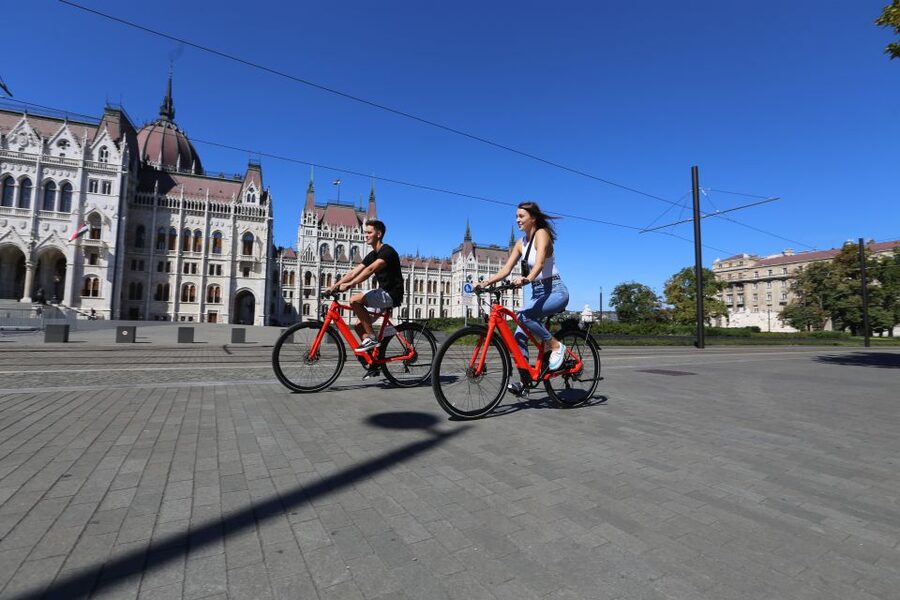
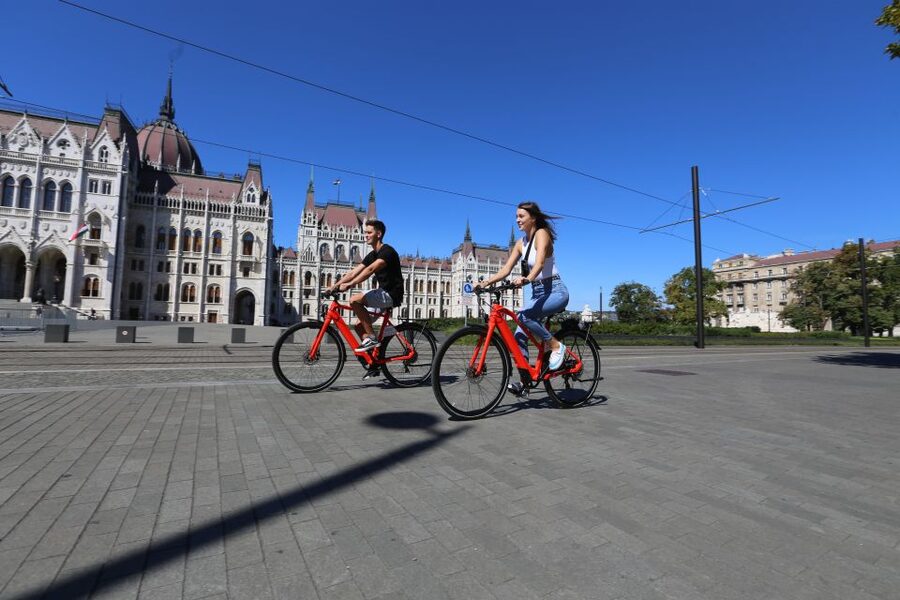
The Hungarian Parliament Building is one of Budapest’s most recognizable sights, with its Gothic Revival profile facing the Danube. The riverfront gives you the classic view toward Buda, where the hills rise behind the water and the castle district sits above the city.
You pass the Monument of the Shoes on the Danube Bank. Direct access cannot always be granted, so do not book this tour expecting a long, quiet visit at the memorial. The guide can still provide the setting and meaning, but the cycling route and conditions may limit how close you get.
The riverfront portion is a highlight for photography. It also makes the city’s geography clear. Pest spreads widely and mostly flat on one bank, while Buda rises quickly on the other. That contrast explains why the electric motor becomes more useful in the next part of the tour.
Crossing the Chain Bridge and climbing to Buda Castle
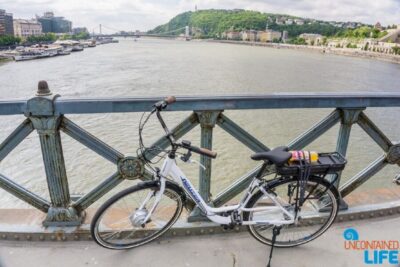
The tour crosses the newly renovated Chain Bridge, now closed to private cars. This changes the feel of the crossing, though conditions and access can vary. From the bridge, look back toward the Parliament side for one of the defining views of Budapest.
Once in Buda, the route climbs Castle Hill. This is the practical test of the e-bike, and the point where the electric assistance earns its keep. You still pedal, but the motor takes much of the sting out of the incline. Riders who are not especially fit can usually keep up more comfortably than they would on a standard bicycle.
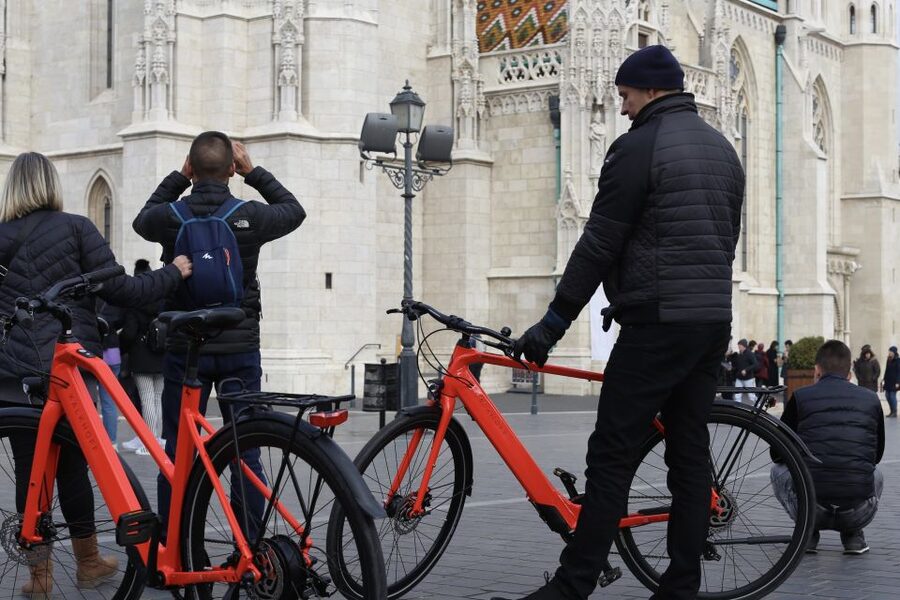
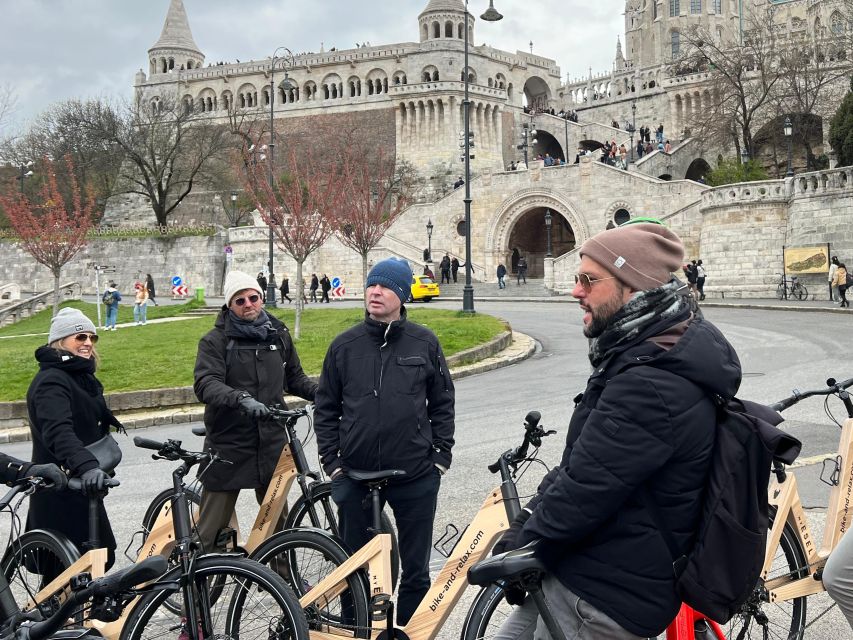
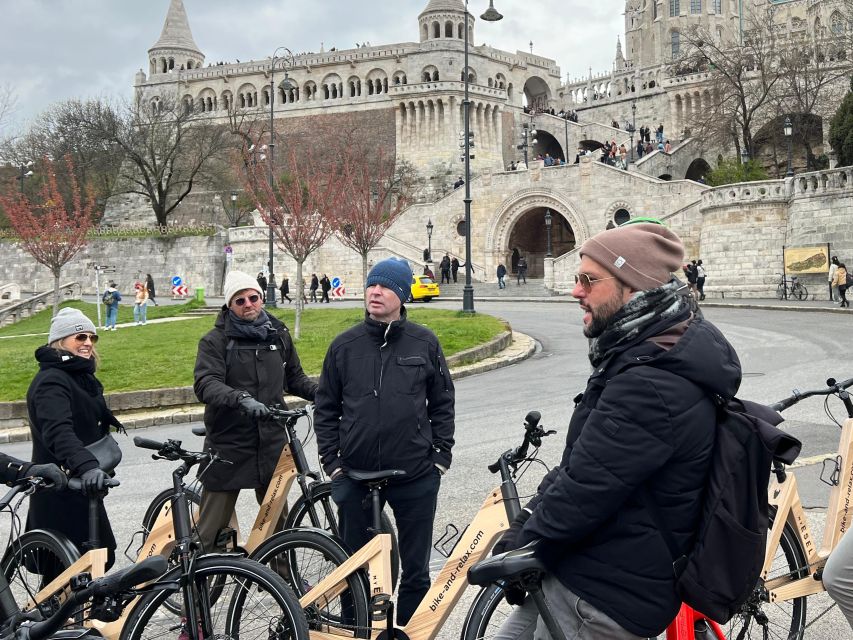
At the top, the tour reaches Matthias Church and Fisherman’s Bastion. Matthias Church is famous for its patterned roof and long role in Budapest’s religious and royal story. Fisherman’s Bastion provides open views across the Danube to Parliament and Pest. You get time for photos and a guide’s explanation, but not an interior tour.
This stop can be busy, and the bike format means you are visiting rather than settling in. I see that as a fair trade for covering so much territory. If Fisherman’s Bastion is high on your list, return later when you can explore at your own pace.
Rudas Bath, Gellért Hill, and Liberty Bridge
The route descends toward the Danube and passes Rudas Bath, a historic thermal bath known for its Ottoman-era character. You see the building from the outside. The same applies to Gellért Thermal Bath, which appears as the tour reaches Gellért Hill on the Buda side.
These bath stops make sense as part of a city overview. Budapest’s thermal culture is not an add-on for tourists; it is one of the city’s defining traditions. The tour helps you identify the main bathhouses so you can decide later where to spend several hours.
You cross back to Pest via Liberty Bridge, one of Budapest’s most popular bridges. The crossing offers another angle on the river, the hills, and the city’s changing architecture. After the hill work, this section feels easier, though you will still have more stops before returning to the shop.
Central Market Hall and the Hungarian National Museum
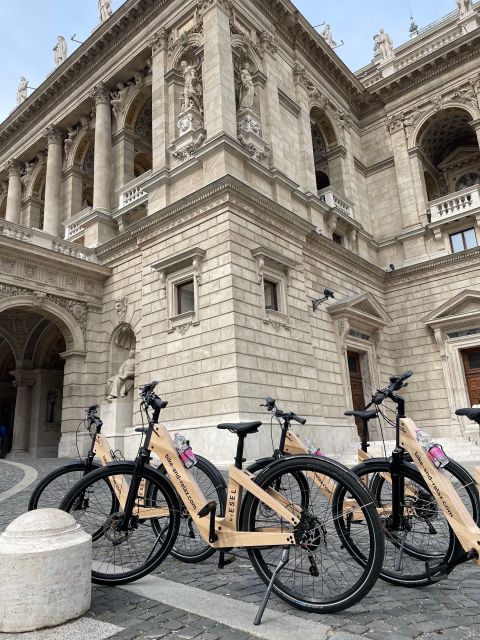
The Central Market Hall is a useful contrast to the ceremonial squares and grand monuments earlier in the route. Its covered market setting points you toward everyday Budapest, food, shopping, and local routines. The tour does not include food or drinks, and this is not a scheduled market meal, so treat it as a quick look rather than a tasting stop.
The Hungarian National Museum is another exterior landmark on the route. Its collections cover Hungary’s past, but you will not enter during the bike tour. If you want detailed exhibits, plan a separate visit and allow enough time to do the building justice.
This late section shows the value of seeing Budapest by bicycle. You can connect the river, market, museum, and Jewish district without spending the rest of the day underground or walking long stretches between them.
Ending at the Dohány Street Synagogue
The final major stop is the Dohány Street Synagogue, in the heart of Budapest’s Jewish district. It is one of the city’s most important Jewish sites and a powerful closing point after the earlier stops at Liberty Square and the House of Terror.
The tour ends back at Bike & Relax. Since the meeting point is near Deák Ferenc tér and Gozsdu udvar, you are well placed for a meal, a drink, or further walking in central Pest. The route begins and ends in a useful part of town rather than at an isolated depot.
Remember that the synagogue, like all the listed landmarks, is viewed from outside. If you want to enter, you will need a separate ticket and visit.
Guide quality and group size
The guide can make or break a city overview, and this format depends heavily on good commentary. The guides named in the available information include Oliver, Karol or Karoly, Katalin, Thomas, Balint, Katy, and Valen. Their approach is described as friendly, calm, humorous, and well informed, with stories that extend beyond dates and building names.
Katalin is particularly strong for travelers who enjoy history and detailed explanation. Oliver is noted for humor and patient answers, while Karol is praised for taking his time and giving personal context. Thomas is described as good at keeping an easy pace, an important point when a group includes different cycling abilities.
The group limit is 10 people. That is small enough for questions and easier for the guide to manage through city streets. It does not make the tour private, however. You may be riding with strangers, and the pace will be set for the whole group.
Is $63 good value for 3.5 hours?
At $63 per person, this is not the cheapest way to see Budapest. You are paying for the bike, electric assistance, a guide, and a route that covers roughly 15 miles according to one participant’s account. You are also paying for time saved between distant districts.
The value is strongest if you are in Budapest for a short stay or want an orientation on your first day. You can see where the major sights sit, note the places you want to revisit, and avoid spending your entire first morning figuring out the city’s layout.
The price is less compelling if you prefer slow museum visits, dislike cycling in traffic, or already know Budapest well. Since admission, food, drinks, and hotel transfers are not included, you should budget separately for the sights you want to enter.
Free cancellation up to 24 hours ahead and reserve-now, pay-later booking add useful flexibility. The tour usually takes about three and a half hours, but road conditions and the group can affect the finish time.
Who should book this Budapest e-bike tour?
I would choose this for first-time visitors who want a broad overview without relying only on public transport. It suits couples, friends, and families with teenagers aged 13 or older. It can also work for riders who are not especially fit, provided they have basic cycling experience and are comfortable with the stated bike restrictions.
The tour is not suitable for children under 13, pregnant women, people with mobility impairments, or anyone who cannot ride a bike. The published limits exclude people under 160 centimeters and people over 110 kilograms. A second height limit of 155 centimeters is also listed, so check your exact fit with the operator before booking if you are close to either threshold.
Weather deserves attention. The route runs outdoors for several hours. Rain ponchos may be available, as they have been provided on wet days, but I would still choose a dry forecast when possible. On hot days, the guide may stop in shaded areas, yet sun and heat can still affect your comfort.
Should you book it?
Book this tour if you want to see a large slice of Budapest in one outing, learn the city’s basic story, and make Castle Hill easier on your legs. The strongest reasons are the broad route, the useful electric assistance, the small group, and guides such as Oliver, Karol, Katalin, and Thomas who bring more personality than a memorized script.
Skip it if your priority is entering museums, baths, churches, or the synagogue, since every landmark is an outside stop. For most first visits, though, $63 is a fair price for a fast orientation, especially when you take it early in your stay and use the rest of your trip to return to the places that caught your attention.
FAQ
How long does the Budapest e-bike tour last?
The tour takes approximately 3.5 hours, although the timing can vary with conditions on the day.
How much does the tour cost?
The listed price is $63 per person.
Where does the tour meet?
Meet at Bike & Relax in central Budapest’s Jewish district, near Madách tér, Gozsdu udvar, and Deák Ferenc tér. Look for Cafe Hivatal beside the shop.
Which languages are available?
The live guides speak English, German, or French.
How many people are in the group?
The tour is limited to 10 participants.
Do I have to pedal an e-bike?
Yes. An e-bike provides electric support, but you still need to pedal.
Are helmets included?
Helmets are available, but wearing one is optional.
Do you enter the attractions?
No. The listed landmarks are viewed from outside, with photo stops and guided explanations.
Who cannot take this tour?
It is not suitable for children under 13, pregnant women, people with mobility impairments, people who cannot ride a bike, people without cycling experience, or people above the stated height and weight limits. Large bags and luggage are also not allowed.
Just added around Budapest
- Budapest: Private, Personalized Pub Crawl, 3 drinks included★ 4.5 · 3 reviews
- Private day trip from Budapest to Bratislava, Vienna, and back★ 3.5 · 3 reviews
- Budapest: Private Adventure Sightseeing Bicycle Tour★ 4.5 · 3 reviews
- Private Danube Bend tour – full day★ 4.5 · 3 reviews
- Budapest: Guided City Walking Tour in Buda and Pest★ 5.0 · 3 reviews
- Budapest Old Jewish Quarter History Private Walking Tour★ 5.0 · 3 reviews
- Lake Balaton Full Day Private Wine Tour★ 5.0 · 3 reviews
- Budapest Urban Feast – Food Tour with Wine Tasting & Coffee House★ 4.5 · 3 reviews
Cycling Tours, compared.

Browse the lists this tour appears in