
Reviewed · WALKING TOURS
Budapest: 3-Hour Walking Tour of Pest with a Historian
Pest comes into focus on this three-hour walk, which links grand squares, river views, a splendid basilica, and the oldest underground railway on the European continent. The best part is the human context: your guide connects Hungary’s past with modern life and welcomes questions on politics, culture, and daily life.
I like the small groups of no more than 10, since you can hear the guide and ask follow-up questions without shouting across a crowd. I also like that the ticket to St. Stephen’s Basilica and the subway rides are included, so the $57 price covers more than a simple walk.
The main consideration is pace. You cover a lot of central Pest in three hours, including a subway ride, so this is an overview rather than a slow visit to every landmark. If you want time for long museum stops or detailed church art, plan to return on your own.
Key points at a glance
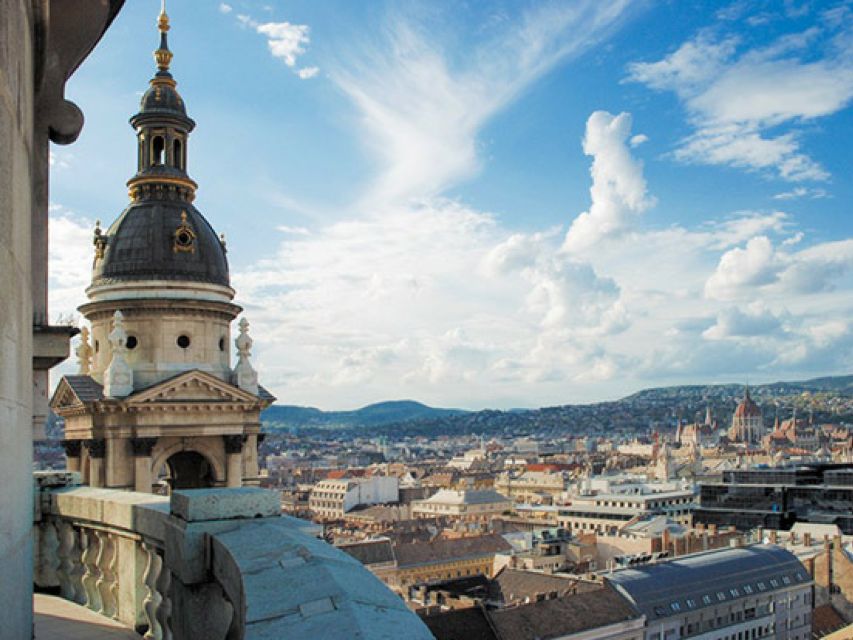
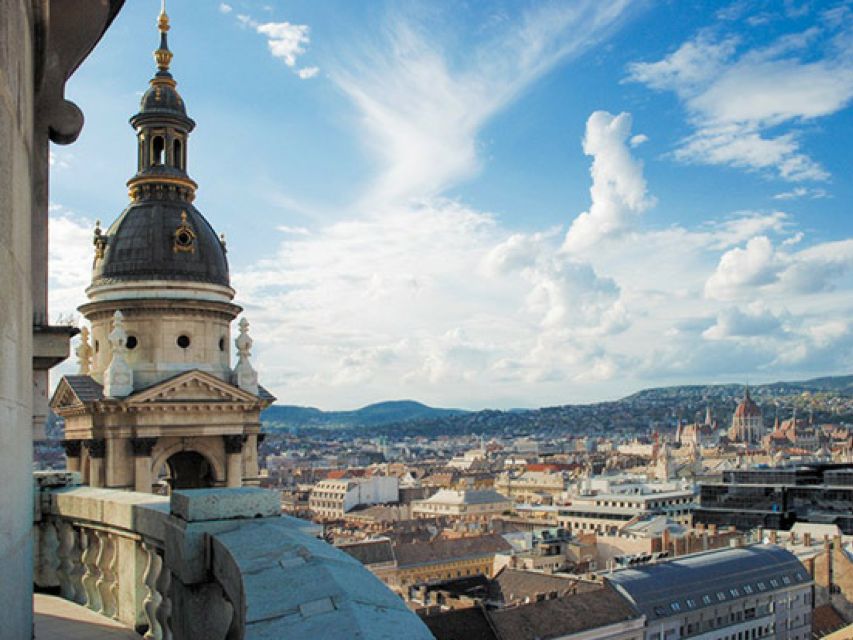
- A historian-led introduction to Pest: Learn how the flat, eastern half of Budapest differs from hilly Buda, both in character and in daily life.
- Inside St. Stephen’s Basilica: The entrance ticket is included, giving you more than an exterior photo stop.
- A ride on the Millennium Underground: Use Budapest’s historic M1 line while learning why it matters.
- Andrássy Avenue and Heroes’ Square: Walk a UNESCO-listed boulevard and trace 1,000 years of Hungarian history at the square.
- Small-group conversation: With up to 10 people, the guide can answer questions and adjust the discussion to your interests.
- A useful first-day tour: The route covers major sights and helps you get your bearings before exploring Budapest alone.
Why Pest makes a strong first walk
Budapest is really two cities joined by the Danube. Buda rises on the western bank, while Pest spreads across the flatter eastern side. This tour stays in Pest, where grand avenues, government buildings, cafés, shops, and busy public squares show a different side of the capital.
That difference is not just about topography. Your guide explains the traditional contrast between Buda and Pest residents, then brings the subject into the present by discussing what it is like to live in Budapest today. This gives you a useful frame for the rest of your stay.
The tour begins in front of Kempinski Hotel Corvinus Budapest at Erzsébet tér, facing the Ferris wheel. The meeting point is easy to reach from the M1, M2, or M3 subway lines at Deák Ferenc tér, as well as by several buses and trams.
I would choose this walk early in a Budapest visit. It gives you a map in your head, a basic timeline of Hungarian history, and practical suggestions for what to see and where to eat. Several guides, including Judit and Barbara, have also tailored the conversation to questions from the group, which is especially helpful on a first visit.
More walking tours in Budapest:
- Budapest: Buda Castle Walk with Saint Stephen’s Hall
★ 4.5 · 3,012 reviews - Big Bus Budapest Hop-On Hop-Off Bus and Walking Tour
★ 3.5 · 2,206 reviews - Budapest: Buda Castle District Walking Tour
★ 4.6 · 2,108 reviews
From the Danube Promenade to Gresham Palace
The route takes in the Danube Promenade, one of central Budapest’s best places to understand the city’s setting. From here, you are close to the river, the grand bridges, and the western hills, even though the tour itself concentrates on Pest.
The promenade is more than a scenic opening. It helps explain why Budapest became such an important capital. The river shaped trade, transport, city planning, and the relationship between Buda and Pest.
From there, expect views of Gresham Palace, an Art Nouveau landmark with an elaborate exterior. The building gives the tour a visual change from the broad riverfront and formal public spaces. Your guide can point out architectural details that are easy to miss when you are simply walking past.
The nearby Hungarian Academy of Sciences adds another layer. Its presence reflects Hungary’s intellectual and cultural life, while the surrounding streets show how much of central Pest was designed to project confidence and civic ambition.
This section is best for travelers who like a city explained through buildings rather than through a list of dates. You get the setting first, then the stories that make the architecture easier to understand.
Zrínyi Street and St. Stephen’s Basilica
Zrínyi Street leads you toward St. Stephen’s Basilica on cobblestones that feel more intimate than the broad avenues nearby. The street is a good example of how Pest shifts quickly between formal urban planning and smaller pedestrian routes.
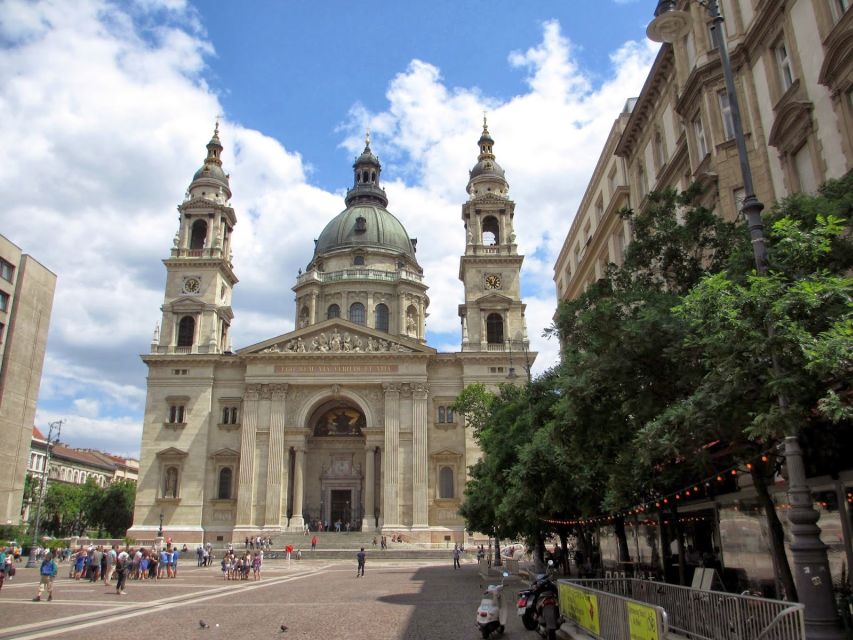
St. Stephen’s Basilica is the main interior visit on the tour. It is described as Budapest’s largest church, and the admission ticket is included in the tour price. That matters because you are not left standing outside while the guide talks about the building. You can enter and see the interior as part of the scheduled route.
The basilica also gives your guide a chance to explain Hungary through religion, national identity, and public memory. The name refers to Stephen I, Hungary’s first king, whose role is central to the country’s early Christian history.
Allow for the fact that a guided visit cannot give you unlimited quiet time inside. The group has other stops ahead, including Andrássy Avenue and Heroes’ Square. If the church becomes your favorite stop, return later for a slower look.
This is one of the clearest value points in the experience. A standard walk might show you the basilica from the square, but this tour includes entry and places it within a larger story about Hungary.
Andrássy Avenue and the Opera House
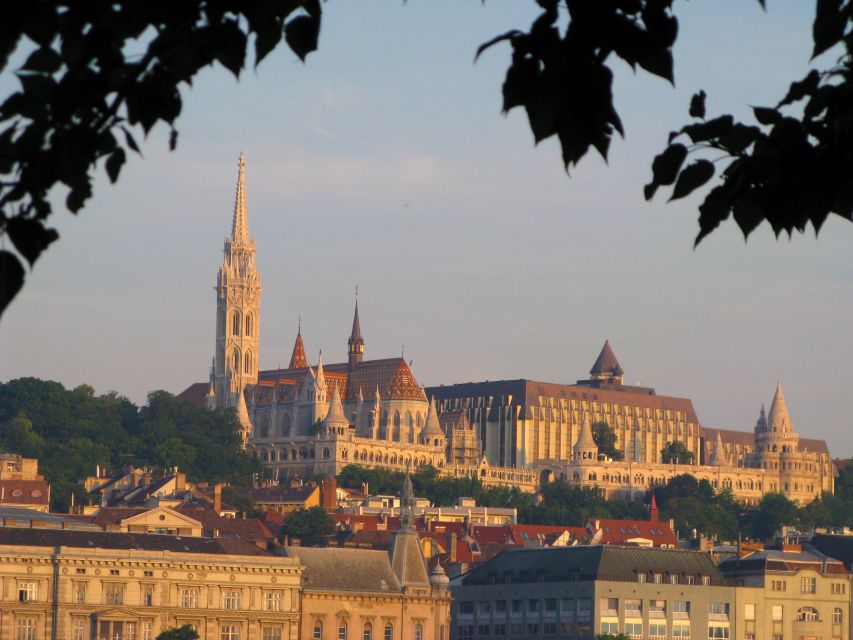
Andrássy Avenue is one of Budapest’s signature routes. The boulevard is part of a UNESCO World Heritage site, and walking it helps you see the capital as a planned European city rather than a collection of unrelated sights.
The avenue connects the inner city with Heroes’ Square. Along the way, your guide points out the Hungarian State Opera and the grand buildings that line the route. You might find the architecture more impressive after hearing why the avenue was created and how it fits into Budapest’s growth.
The Opera House is an exterior stop on this experience, not a performance visit. That distinction is important if you are hoping to tour the inside or attend a concert. You can note it for a later visit, but the walking tour focuses on the street and the surrounding urban design.
I like this part because it slows the tour into a long visual story. The buildings do not arrive one at a time as isolated attractions. They form a procession, and the guide helps you read the avenue as a whole.
The route is still active and urban. You will be walking on city streets rather than through a quiet park, and the group must keep moving to cover the full distance. Comfortable shoes are a sensible choice, especially with cobblestones earlier in the walk.
A few more Budapest half-days to weigh up
- 3-Hour Orientation Walking Tour of Buda and Pest
★ 4.8 · 1,834 reviews - Budapest: 3-Hour Grand City Tour and Castle Walk
★ 4.3 · 1,437 reviews - Budapest: 3-Hour Live Guided Sightseeing Tour
★ 4.4 · 1,041 reviews - 3 Hours Budapest Segway Grand City Tour Buda, Margaret and Pest
★ 5.0 · 255 reviews
Riding Budapest’s Millennium Underground
One of the tour’s most distinctive features is a ride on the Millennium Underground. This is Budapest’s M1 line, described as the oldest underground railway on the European continent.
The subway ticket is included, and the ride breaks up the walking. It also shows you how transportation helped Budapest expand beyond its older center. The line is not simply a practical transfer between two stops. It is part of the city’s story and connects the inner city with the Heroes’ Square area.
You should think of this as a short historic transit experience, not a long subway tour. The focus remains on getting from one part of the route to another while explaining why the line matters.
This is especially useful if you are interested in infrastructure, city planning, or everyday urban life. It adds something you would not get from a standard sightseeing loop, where the guide might simply move between attractions on foot.
One thousand years at Heroes’ Square
Heroes’ Square is the grand finale of the route. Its statues represent important figures from Hungarian history, and the square offers a compact way to discuss the country’s long and often complicated past.
The tour presents roughly 1,000 years of Hungarian history here, with attention to the people who shaped the nation. That does not mean you will receive a full academic lecture on every period. Instead, the square acts as a visual outline, giving you names, symbols, and a timeline you can build on later.
This is where the guide’s ability to explain context matters most. Hungary’s story includes the Austro-Hungarian Empire, the Second World War, and the Communist era. Guides such as Andrea and Greg have been praised for making these periods understandable without reducing them to a string of dates.
The square itself is spacious and formal, a sharp contrast to Zrínyi Street and the close city blocks near the basilica. It gives the group room to pause, look across the monument, and connect the earlier parts of the walk.
The tour does not claim to cover every Hungarian historical debate. That is a benefit as much as a limitation. You get a clear foundation, then have the chance to ask about the periods that interest you most.
The guides make the difference
This experience depends heavily on the person leading it. The guide roster has included Judit, Barbara, Monica, Andrea, Raymond, Greg, Gergely Molnár, Noemi, and others. Their shared role is to explain both the sights and the country behind them.
Judit has been described as especially good at answering questions about Hungarian history, culture, politics, and current affairs. She has also added small local touches, including tastings of two popular sweets on one occasion. That kind of moment is not promised as part of the formal itinerary, so treat it as a possible bonus rather than a guaranteed feature.
Monica has brought personal memories of growing up in Hungary into the storytelling. That can make the Communist period and later changes feel less abstract. Gergely Molnár has used a short overview of Hungarian history at the start, which gives the rest of the tour a useful framework.
Greg has led visitors through Pest at a steady pace while explaining the complex history of the area. Barbara has offered practical ideas about what to see and where to eat, a helpful addition if you are new to Budapest.
The consistent strength is conversation. You can ask about almost any aspect of Budapest or Hungary, and the small group makes that possible. If you prefer a guide who sticks strictly to prepared facts with little discussion, this may feel more open-ended than expected.
What $57 buys you
At $57 per person, this is not the cheapest way to walk around Pest. You can see many exteriors for free, and Budapest has plenty of self-guided material.
The value comes from combining several useful elements:
- Three hours with an English-speaking historian
- Entry to St. Stephen’s Basilica
- Subway tickets for the Millennium Underground ride
- A small group limited to 10 participants
- An organized route linking the Danube, central Pest, Andrássy Avenue, and Heroes’ Square
- Time for questions about Hungarian history and present-day life
The basilica admission and subway tickets only account for part of the price. The bigger benefit is having someone explain why the places matter and how they fit together.
I consider it good value if you want a serious introduction to Budapest and do not want to spend your first day working out the city alone. It is less useful if you already know Pest well or prefer to wander without a fixed route.
The tour also has practical booking flexibility. You can cancel up to 24 hours before the start for a full refund, and you can reserve now and pay later. Starting times vary, so check availability before planning the rest of your day.
Who should book this Pest walk?
I would recommend it to first-time visitors who want more than surface sightseeing. It suits people who enjoy history, architecture, urban planning, and conversation with a local guide.
It is also a good fit for a short Budapest stay. In three hours, you see enough of central Pest to decide where you want to return, while the route includes sights that might otherwise take careful planning to connect.
Families with older children and teenagers may appreciate the mixture of walking, buildings, statues, and a subway ride. The historic transport element gives the tour a change of pace, and the guide can respond to questions instead of delivering one fixed speech.
The walk may be less suitable for anyone seeking a relaxed half-day with long stops. You cover a substantial part of Pest, and the schedule has to keep moving. I would also avoid booking it immediately before a timed attraction unless you leave a generous buffer.
The experience is conducted in English. Group size is limited to 10, but the exact starting time depends on availability.
Final decision: book it for context, not just checkmarks
I would book this tour if I wanted to understand Budapest quickly and still have room for questions. The combination of St. Stephen’s Basilica, the Millennium Underground, Andrássy Avenue, and Heroes’ Square gives you a well-shaped introduction to Pest.
Its strongest feature is the guide-led context. Judit, Greg, Andrea, Barbara, Monica, and the other guides have brought different personal styles, but the experience is built around clear explanations and open discussion.
Skip it if you want a slow architectural study, a full Opera House visit, or a tour focused only on the most famous photo stops. Choose it if you want to leave your first Budapest walk knowing not only what you saw, but why Pest developed as it did and how its past still shapes life today.
FAQ
Where does the tour meet?
The meeting point is in front of Kempinski Hotel Corvinus Budapest, facing the Ferris wheel on Erzsébet tér. The address is Erzsébet tér 7, 1051 Budapest.
How long does the walking tour last?
The tour lasts three hours.
What language is the tour conducted in?
The live tour guide conducts the experience in English.
How many people are in the group?
The group is limited to 10 participants.
Is entry to St. Stephen’s Basilica included?
Yes. The entrance ticket to St. Stephen’s Basilica is included.
Are subway tickets included?
Yes. Subway tickets for the tour are included, including the ride on the Millennium Underground.
Which main sights are included?
The route includes the Danube Promenade, Gresham Palace, the Hungarian Academy of Sciences, Zrínyi Street, St. Stephen’s Basilica, Andrássy Avenue, the Hungarian State Opera, the Millennium Underground, and Heroes’ Square.
How much does the tour cost?
The listed price is $57 per person.
Can I cancel the booking?
Yes. You can cancel up to 24 hours in advance for a full refund. You can also reserve now and pay later.
Just added around Budapest
- Budapest: Private, Personalized Pub Crawl, 3 drinks included★ 4.5 · 3 reviews
- Private day trip from Budapest to Bratislava, Vienna, and back★ 3.5 · 3 reviews
- Budapest: Private Adventure Sightseeing Bicycle Tour★ 4.5 · 3 reviews
- Private Danube Bend tour – full day★ 4.5 · 3 reviews
- Budapest: Guided City Walking Tour in Buda and Pest★ 5.0 · 3 reviews
- Budapest Old Jewish Quarter History Private Walking Tour★ 5.0 · 3 reviews
- Lake Balaton Full Day Private Wine Tour★ 5.0 · 3 reviews
- Budapest Urban Feast – Food Tour with Wine Tasting & Coffee House★ 4.5 · 3 reviews
Walking Tours, compared.
Budapest City Landmarks Walking Tour in 2 Hours
Read our review →
3-Hour Orientation Walking Tour of Buda and Pest
Read our review →
Budapest All in One Small Group Walking Tour with Strudel Stop
Read our review →
Buda Castle District Walking Tour with a Historian
Read our review →
BloodThirsty Hungary: Walking tour & Dark Historical Stories
Read our review →
Browse the lists this tour appears in