
Reviewed · BUDA CASTLE DISTRICT TOURS
Buda Castle Walking Tour: A Kingdom of Many Nations
Buda Castle is not simply one palace waiting to be admired. It is a whole hilltop district where royal power, Ottoman rule, Habsburg rule, war, and modern Hungary meet in narrow lanes and rebuilt façades. This small-group walking tour gives you the stories needed to make sense of what you see.
I like the maximum six people per booking, since a guide such as Peter or Kata can adjust the pace and answer real questions. I also like the personal angle: guides have connected the streets to family stories, including one guide’s grandmother’s house in the district. The main drawback is clear: entrance fees are extra, and you do not tour the palace interior.
Key points to know before booking

- Castle Hill is an old town district, not just a castle visit: Expect streets, courtyards, churches, official buildings, and viewpoints.
- The group stays small: A booking can include up to six people, while the activity allows a maximum of eight travelers.
- Matthias Church is the main paid highlight: Its patterned roof and ornate interior add a strong visual payoff, but admission is not included.
- The guide makes the difference: Kata, Peter, Gregory, Marianna, Veronica, Runa, and others have been praised for clear history, flexible pacing, and personal stories.
- Fisherman’s Bastion provides the big city view: You can see the Danube, Pest, Margaret Island, and Gellért Hill from its terraces.
- Plan for three hours on foot: Wear practical shoes and think of this as a history walk, not a quick photo stop.
Why Castle Hill deserves three hours
Budapest is split by the Danube, but Buda’s Castle Hill feels like a separate town above the river. Its cobbled streets and old façades invite a slower look. The hill’s two visual anchors are the huge palace at the southern end and Matthias Church near the center, with its sharp steeple and colorful roof.
This tour helps you read the district in layers. You begin with the medieval fortress founded after the Mongol invasion, move through the Renaissance court of King Matthias, then follow the area through Ottoman rule and the Habsburg period. The modern appearance is just as important, since much of the district suffered major damage during World War II and was rebuilt afterward.
That context matters. Without it, you may see an attractive square and assume every wall is centuries old. With a guide, you can separate original medieval fabric, later additions, reconstruction, and buildings that changed purpose over time.
The tour is offered in English and lasts about three hours. Morning or afternoon departure depends on the day. Since it is a walking experience with several outdoor viewpoints, your comfort will depend more on the weather and your shoes than on physical exertion. Most people can take part, and the route is near public transportation.
More ways to see the Castle District:
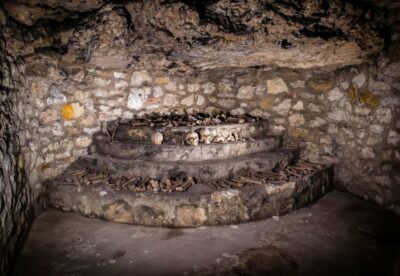
- Budapest: Buda Castle Cave Tour
★ 4.7 · 5,677 reviews - Budapest: Buda Castle District Vampires and Myths Night Tour
★ 4.6 · 3,830 reviews - Budapest: Buda Castle Walk with Saint Stephen’s Hall
★ 4.5 · 3,012 reviews
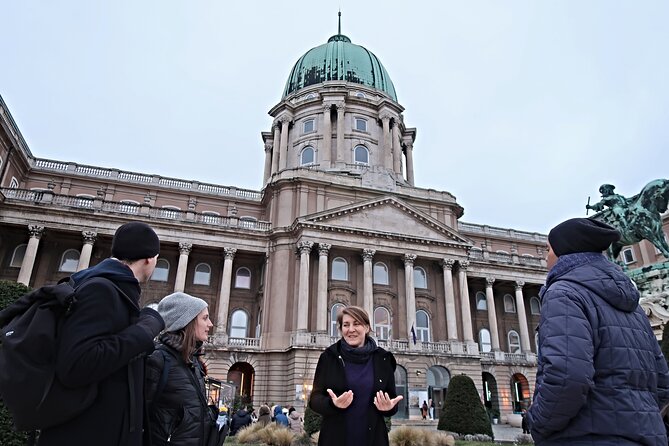
Starting among the palace walls
The meeting point is at Budapest, Országház u. 31, in the Castle District. From there, the walk begins around the palace complex, the former center of royal power.
The palace you see today is not a single untouched medieval building. It was built, expanded, altered, burned, and rebuilt many times. Its present eclectic appearance largely took shape after World War II, which makes it useful to think of the palace as a record of Budapest’s repeated changes rather than a perfectly preserved royal residence.
Your guide explains the building’s shifting role. It began as a fortress site under King Béla IV, who built on Castle Hill around 1250 after the Mongol invasion devastated Hungary. Later, King Matthias turned the court into one of Europe’s leading Renaissance centers in the late 15th century.
Then the political story changed sharply. Ottoman pashas ruled Hungary for more than 150 years, followed by Habsburg emperors. Each period left a mark on the hill’s function and appearance. The palace was not merely a royal home. It became a seat of administration, a symbol of foreign control, and eventually part of a modern national capital.
You spend about two hours in the Castle District area, followed by shorter stops at the main landmarks. That gives the guide time to explain more than a list of dates. The strongest guides, including Peter, Gregory, and Marianna, have been praised for connecting national events to everyday life and present-day Hungary.
The palace portion is also where you should set your expectations. Admission is listed as free for the walking stop, but this does not mean you receive an interior palace tour. The experience focuses on the outside setting, history, and changing function of the complex.
Sándor Palace and the modern state
A short stop at Sándor Palace adds a useful modern chapter. The Neoclassical building dates to 1806 and was commissioned by Count Vincent Sándor, an aristocrat and philosopher of the Austro-Hungarian Empire.
Since 2003, it has served as the official residence of the President of Hungary and the home of the Office of the President. Your guide uses the building to show how Castle Hill remains a working political center, not a museum district frozen in the past.
The stop lasts about five minutes, so do not expect a long visit inside. Its value is in the contrast. You have just been discussing kings, Ottoman pashas, and Habsburg rulers. Now you are looking at a building linked to the modern Hungarian republic.
Matthias Church, the paid highlight
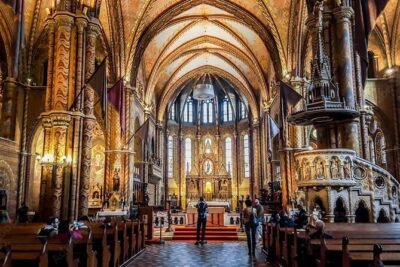
Matthias Church is likely to be the visual high point of the walk. Its roof is covered with intricate colored patterns, and its interior is heavily decorated. The structure looks medieval at first glance, but the building is largely a carefully executed Neo-Gothic reconstruction from the late 19th century.
That distinction is worth knowing before you arrive. The church is not less interesting because it was rebuilt. In fact, its later design shows how 19th-century Hungary imagined and presented its national past. The result is dramatic, ornate, and very different from the severe stone image many people expect from a medieval church.
Matthias Church also carries royal meaning. It was a coronation site for Hungarian kings, so the guide can connect the decoration and setting to the country’s former monarchy. The church’s position in the middle of the district makes it a natural pause after the palace discussion.
Admission is not included. The tour data specifically lists tickets for Matthias Church as an extra cost, so budget for that separately. One practical point is important: some guides may offer to lead you through the church, but the entrance fee remains your responsibility.
If you care about interiors, religious art, or architecture, I would treat this ticket as worthwhile. If you prefer an outdoor history walk and city views, you can still gain a lot from the exterior and surrounding streets, but you should know that the church visit is one of the tour’s main added expenses.
More walking tours in Budapest:
- Big Bus Budapest Hop-On Hop-Off Bus and Walking Tour
★ 3.5 · 2,206 reviews - Budapest: Buda Castle District Walking Tour
★ 4.6 · 2,108 reviews - Budapest City Landmarks Walking Tour in 2 Hours
★ 5.0 · 2,048 reviews - 3-Hour Orientation Walking Tour of Buda and Pest
★ 4.8 · 1,834 reviews
Fisherman’s Bastion and the best views

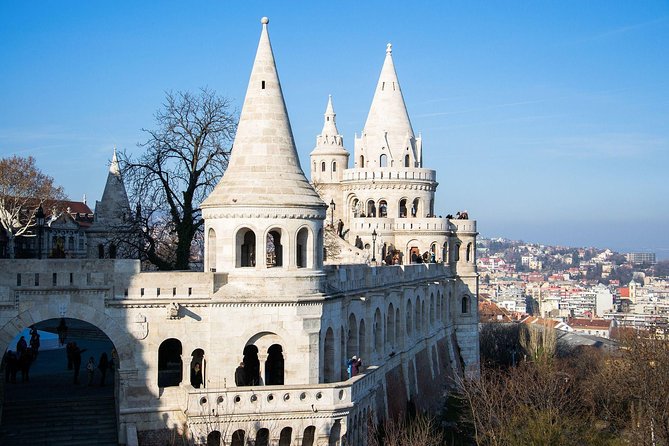
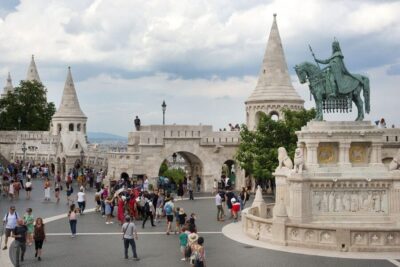
Fisherman’s Bastion looks like a medieval fortress, but it is an architectural fantasy built between 1895 and 1902 in Neo-Gothic and Neo-Romanesque styles. Its seven towers represent the seven Magyar tribes that settled in the Carpathian Basin at the end of the ninth century.
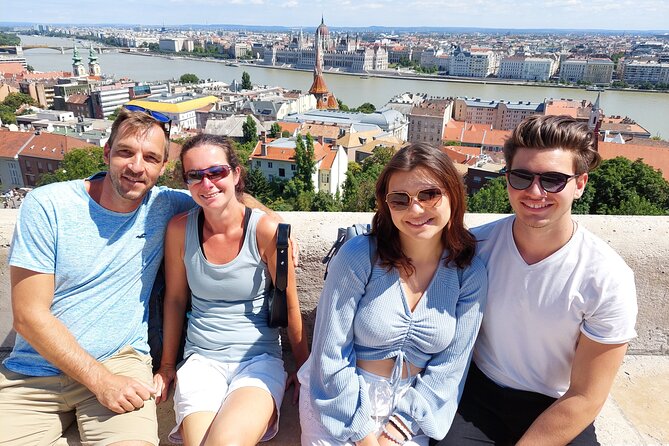
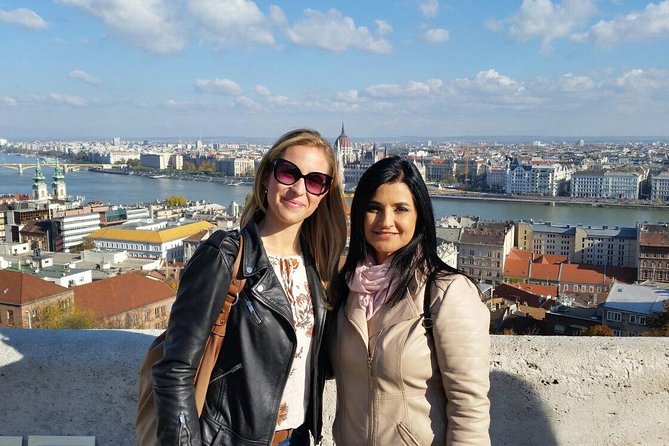
This is the photo stop, but it is not only about photographs. From the terraces, you can look across the Danube toward Pest, Margaret Island, and Gellért Hill. The view gives you a quick geography lesson: Budapest makes much more sense when you can see both sides of the river from above.
Fisherman’s Bastion tickets are also not included. That means the advertised price does not cover every paid feature you may want to enter. Ask your guide how the ticketed areas fit into the walk, and bring a little flexibility to your plans.
I like the way this stop balances the heavier historical material. After hearing about invasions, occupation, war, and reconstruction, you get time to look outward at the present-day city. The terrace is a strong reason to schedule the tour early in your Budapest stay, since it can help you understand the city before exploring Pest on your own.
Vienna Gate and the walk’s final view

The tour ends at Vienna Gate, on the northern side of the district. From here, you can see toward Óbuda, or Old Buda, where the Romans founded the settlement known as Aquincum.
This ending makes sense geographically and historically. You have walked through the seat of medieval royal power, seen a modern presidential residence, visited a coronation church, and looked across the river from Fisherman’s Bastion. At Vienna Gate, the view points back toward the Roman roots of the wider city.
The stop lasts about ten minutes. Since the tour ends in Budapest rather than returning you to a hotel, you should plan your next move in advance. The tour does not include hotel pickup or drop-off.
The guide is the real value
A three-hour history walk can feel dry if the guide simply recites rulers and dates. Here, the guide’s approach matters a great deal. The strongest feedback centers on guides who connect facts to people, buildings, and modern life.
Kata is described as energetic, patient, and especially good at linking Hungarian history to the present. She has also been praised for adjusting the pace and answering questions in detail. Peter has received similar praise for his command of the Castle District and for adapting the walk to the group’s interests.
Gregory has been singled out for broad knowledge of Budapest, Hungary, and world events, while Marianna has brought the period of Soviet occupation into the conversation through personal stories. Veronica has been valued for making the rebuilt district engaging, even for someone who arrived expecting a conventional castle tour.
Runa has helped visitors with public transportation, and one account describes her meeting the group at a hotel at her own expense. That was not a stated part of the tour, so do not book expecting hotel pickup. Still, it shows the kind of practical help a flexible guide may provide.
The best detail is the local connection. One guide who grew up in the Buda area showed the group a grandmother’s house and explained the story tied to it. Details like that give the district a human scale. You are not just hearing about an occupying army or a political era. You are seeing where local lives fit into the larger story.
The experience has a 4.9 rating from 32 reviews, with 97 percent recommending it. Those numbers suggest strong consistency, but I would still remember that the guide assignment can shape your experience. The tour is best for people who value conversation and interpretation more than a fixed script.
What the $126.15 price means

At $126.15 per person, this is not the cheapest way to walk around Castle Hill. You are paying for a professional English-speaking guide, a three-hour route, and a small group rather than a large crowd.
The value improves if you are traveling with a small party and want to ask questions. A guide can adapt the route and explanation to family heritage, architecture, politics, or daily life. Several guides have been praised for changing the pace and focus to suit the group.
The price is less attractive if you only want landmark photos. You can see the exterior of the palace, Sándor Palace, Matthias Church, Fisherman’s Bastion, and Vienna Gate without paying for a guided walk. The extra cost buys the connections between them, not exclusive access to the district.
You should also add the cost of Matthias Church and Fisherman’s Bastion if you plan to enter their paid areas. Food, drinks, transportation, and hotel transfers are not included.
For me, the tour offers its best value on a first or second day in Budapest. The guide gives you a framework for later independent exploring. It is also a strong choice before a river cruise, when you want more historical context than a short ship excursion may provide.
Who will enjoy this walk most
I would recommend this tour to you if you like history explained through buildings and personal stories. It suits first-time visitors, people with Hungarian family roots, and anyone who wants a calm introduction to Buda before setting off alone.
It is especially useful if you are unsure how to interpret the Castle District. The area is beautiful, but its rebuilt façades and changing political roles can be confusing without background.
The tour may not suit you if you need a fully private experience, want to explore palace interiors, or dislike paying extra for church and viewpoint access. Though the group is small, the activity allows up to eight people, and the price is higher than an ordinary self-guided walk.
Wear comfortable shoes. The route includes narrow streets, cobbles, and several outdoor viewpoints. Choose the morning or afternoon departure based on your wider Budapest plans and the weather.
Free cancellation is available up to 24 hours before the start time. Changes or cancellations made later are not accepted for a refund.
Should you book Buda Castle: A Kingdom of Many Nations?
Book it if you want the Castle District to make sense, not just look pretty. The palace, Matthias Church, Fisherman’s Bastion, Sándor Palace, and Vienna Gate are worthwhile sights on their own, but the guide supplies the political and personal links that tie them together.
I would book this for a small party, a first visit, or a family interested in Hungarian roots. The combination of small numbers, three hours, and guides such as Kata, Peter, Gregory, and Marianna gives the walk a personal feel.
Skip it if you only want a quick circuit of viewpoints or expect to go inside the main palace. And remember the extra entrance fees. For an attentive history walk through Budapest’s oldest quarter, though, this is a strong, focused choice.
FAQ
How long is the Buda Castle walking tour?
The guided walk lasts approximately three hours.
Where does the tour start?
It starts at Budapest, Országház u. 31, 1014 Hungary, in the Buda Castle District.
Where does the tour end?
The tour ends at Vienna Gate in Budapest.
Is the tour offered in English?
Yes. The tour is offered in English.
How many people can join the tour?
A booking can include a maximum of six people. The activity itself allows a maximum of eight travelers.
Are entrance fees included?
No. Tickets for Buda Castle, Matthias Church, and Fisherman’s Bastion are not included. The walking tour and professional guide are included.
Is hotel pickup included?
No. Hotel pickup and drop-off are not included.
Is food included?
No. Food and drinks are not included unless specifically stated.
Can most people participate?
Yes. The tour information says most travelers can participate and notes that it is near public transportation.
What is the cancellation policy?
You can cancel up to 24 hours before the experience start time for a full refund. Cancellations or changes made less than 24 hours before the start time are not accepted for a refund.
Just added around Budapest
- Budapest: Private, Personalized Pub Crawl, 3 drinks included★ 4.5 · 3 reviews
- Private day trip from Budapest to Bratislava, Vienna, and back★ 3.5 · 3 reviews
- Budapest: Private Adventure Sightseeing Bicycle Tour★ 4.5 · 3 reviews
- Private Danube Bend tour – full day★ 4.5 · 3 reviews
- Budapest: Guided City Walking Tour in Buda and Pest★ 5.0 · 3 reviews
- Budapest Old Jewish Quarter History Private Walking Tour★ 5.0 · 3 reviews
- Lake Balaton Full Day Private Wine Tour★ 5.0 · 3 reviews
- Budapest Urban Feast – Food Tour with Wine Tasting & Coffee House★ 4.5 · 3 reviews
Buda Castle District Tours, compared.

Buda Castle District Vampires and Myths Night Tour
Read our review →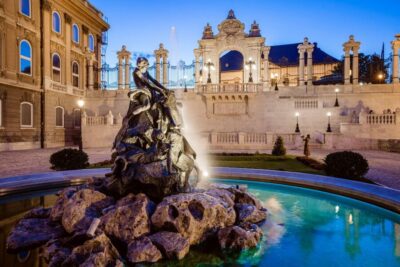

Buda Castle District Dark History, Legends and Vampire Night Tour
Read our review →
Buda Castle District Walking Tour with a Historian
Read our review →
Browse the lists this tour appears in