

Reviewed · BUDA CASTLE DISTRICT TOURS
Buda Castle Private Walking Tour: A Kingdom of Many Nations
Budapest’s Castle Hill is not just a pretty overlook. It is a compact record of Hungarian kings, Ottoman rulers, Habsburg power, war, rebuilding, and modern government. This private walk makes that story the main event, moving from the royal palace to Matthias Church, Fisherman’s Bastion, and the Vienna Gate.
I like the private guide and the strong historical focus. You can ask questions, set the pace, and get more than a string of dates. I also like the route’s mix of grand buildings and broad Danube views, especially from Fisherman’s Bastion. The main consideration is that the tour does not include admission to Matthias Church or Fisherman’s Bastion, and the name Buda Castle can suggest a single preserved medieval castle that you will not actually find.
Key things to know before booking
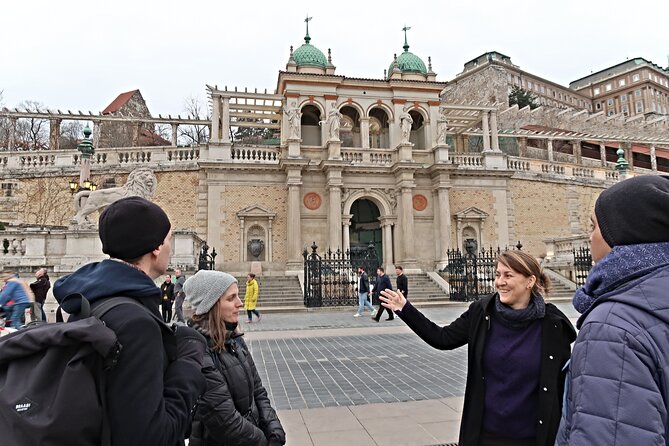
- A historian-led walk puts the palace in context: You hear how the site changed from medieval fortress to Renaissance court, Ottoman seat, Habsburg residence, and postwar reconstruction.
- The three-hour route covers Castle Hill’s main sights: The palace, Sándor Palace, Matthias Church, Fisherman’s Bastion, and Vienna Gate all fit into one focused outing.
- Kata and Julia are named guides associated with the experience: Guide assignment is not guaranteed, but the tour is designed around detailed, personal explanation.
- Tickets are extra: The guided walk is included, but Matthias Church and Fisherman’s Bastion admission are not.
- The views are part of the payoff: Fisherman’s Bastion looks across the Danube toward Pest, Margaret Island, and Gellért Hill.
- The group price favors small parties: At $397.36 for up to 10 people, the cost can make sense for a family or group traveling together, but less so for one or two people.
Why Castle Hill makes a good private walking tour
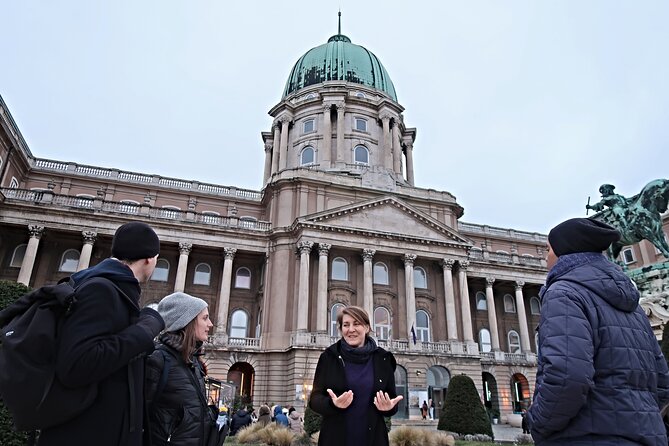
Castle Hill is Budapest’s oldest part, and its appeal comes from contrast. Narrow cobbled streets lead past Baroque and Gothic facades, while the southern end opens onto the enormous palace complex. In the middle of the hill, Matthias Church brings a very different mood with its patterned roof and ornate interior.
A guide helps you connect these pieces. Without context, you might see a palace that looks grand but hard to date, a church that appears medieval but is largely a nineteenth-century reconstruction, and a lookout that looks old but was built around the turn of the twentieth century. The story is not always obvious from the stonework.
The private format matters here. With your own guide, you can stop to ask why the palace looks so different from a medieval fortress, or how Turkish and Habsburg rule changed the hill. The guide can also spend more time on the parts that interest you instead of following a fixed script for a large crowd.
The tour is offered in English, with morning and afternoon departure choices. That gives you some control over how it fits into a Budapest sightseeing day. A morning walk can leave the rest of the day open, while an afternoon start may work well after time in Pest.
More ways to see the Castle District:
- Budapest: Buda Castle Cave Tour
★ 4.7 · 5,677 reviews - Budapest: Buda Castle District Vampires and Myths Night Tour
★ 4.6 · 3,830 reviews - Budapest: Buda Castle Walk with Saint Stephen’s Hall
★ 4.5 · 3,012 reviews
Meeting your guide at Országh utca
Unless hotel pickup has been arranged, you meet 15 minutes before departure at Bálthazár, a hotel with a café at Országh utca 31. It is about 50 meters from the first bus stop on Castle Hill, at Bécsi kapu tér.
That meeting point is useful if you are already on the hill, but it deserves a little planning. Castle Hill has several roads, stops, and entrances, so do not leave the meeting point until the last minute. The tour is near public transportation, and pickup is offered if arranged, but the standard plan is to meet at the stated address.
The walk ends at Vienna Gate rather than returning to the starting point. I like that arrangement because it gives the route a clear direction and brings you to the northern side of the hill. You will need to plan your next move from there.
The walk lasts about three hours. Most people can take part, but Castle Hill’s cobbles and walking route mean comfortable shoes are sensible. The information provided does not specify a stair-free route or special accessibility arrangements, so ask the operator before booking if that is important for you.
The palace and the problem with the name Buda Castle
The first major section centers on the palace at the southern tip of Castle Hill. It was the seat of royal power, but it is not a simple medieval building preserved in one piece. It was rebuilt, enlarged, altered, burned, and rebuilt again over many centuries.
King Béla IV began the fortress on Castle Hill around 1250, after Mongol forces devastated the country. Later, King Matthias turned the court into one of Europe’s most famous Renaissance centers in the late fifteenth century. That period gives the site some of its greatest historical drama: the hill was not only a defensive position, but also a royal center linked to art, politics, and power.
Then the Turkish pashas ruled Hungary for more than 150 years. After them came the Habsburg emperors. Each period left a different mark on the role and appearance of the palace.
The palace’s present eclectic appearance largely comes from rebuilding after World War II. That detail is worth knowing before you arrive. If you expect a perfectly preserved medieval castle with original interiors throughout, you may feel let down. The value is in understanding the layers and the changing function of the site, not in seeing one untouched fortress.
Your guide spends time explaining what the building was used for in different periods. That is one of the strongest reasons to choose this experience over a quick photo stop. You learn how the same hill could serve as fortress, royal court, seat of foreign rule, imperial property, and modern cultural site.
The palace portion is listed as about two hours of the walk’s Castle Hill focus, followed by shorter stops. Since the overall tour lasts three hours, expect the guide to balance outdoor explanation with visits and viewpoints rather than provide a long interior museum tour.
Sándor Palace and modern Hungarian power

A short stop at Sándor Palace adds a useful modern link to the older royal story. Built in Neoclassical style in 1806 for Count Vincent Sándor, an aristocrat and philosopher of the Austro-Hungarian Empire, the building has served as the official residence of Hungary’s president and the seat of the Office of the President since 2003.
You spend only about five minutes here, so this is an exterior orientation rather than a full palace visit. Still, it helps you see that Castle Hill is not frozen in the past. Government power continues to occupy the hill, just in a different form from the days of medieval kings and Habsburg rulers.
This quick stop works best when you treat it as part of the larger story. The guide can show how authority moved from royal palace to imperial administration and then to the modern Hungarian state.
More walking tours in Budapest:
- Big Bus Budapest Hop-On Hop-Off Bus and Walking Tour
★ 3.5 · 2,206 reviews - Budapest: Buda Castle District Walking Tour
★ 4.6 · 2,108 reviews - Budapest City Landmarks Walking Tour in 2 Hours
★ 5.0 · 2,048 reviews - 3-Hour Orientation Walking Tour of Buda and Pest
★ 4.8 · 1,834 reviews
Matthias Church, rebuilt in Gothic style
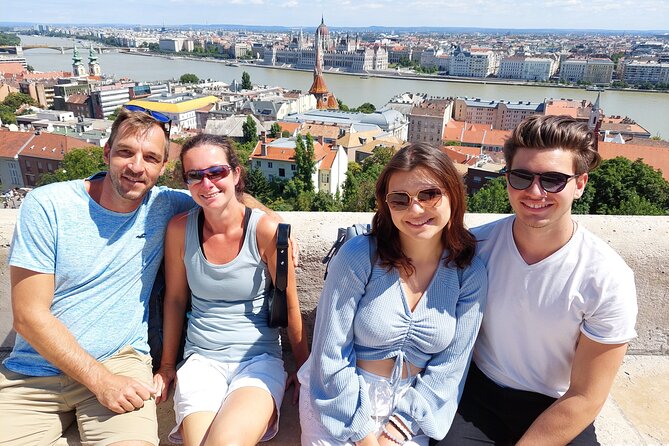
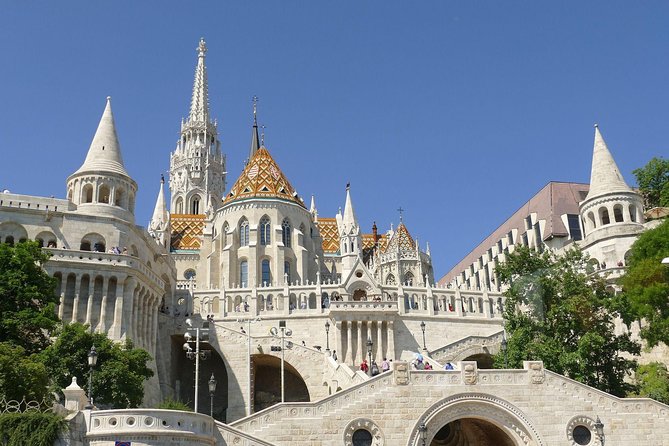
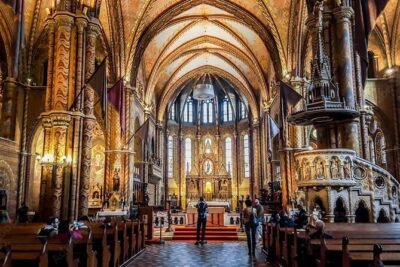
Matthias Church is one of the visual highlights of the walk. Its roof is covered in bright decorative patterns, and the interior is known for elaborate decoration. The church is often associated with medieval Hungarian kings, but the building you see is largely a carefully executed Neo-Gothic reconstruction from the late nineteenth century.
That distinction does not make it less worthwhile. In fact, it makes the building more interesting. You are looking at a nineteenth-century vision of medieval Hungary, shaped by restoration and national identity. The guide can help you separate the original medieval story from the later reconstruction.
The tour allows about 20 minutes at the church. That is enough for an introduction and a focused look, but it may feel brief if you want to study every detail inside. Admission is not included, so budget separately for your ticket.
The church is a good example of why this tour needs explanation. Its appearance feels old, but its present form reflects a later period. A guide who can point out that tension turns a quick visit into a lesson in how cities rebuild and reinterpret their past.
Fisherman’s Bastion and the big Danube view
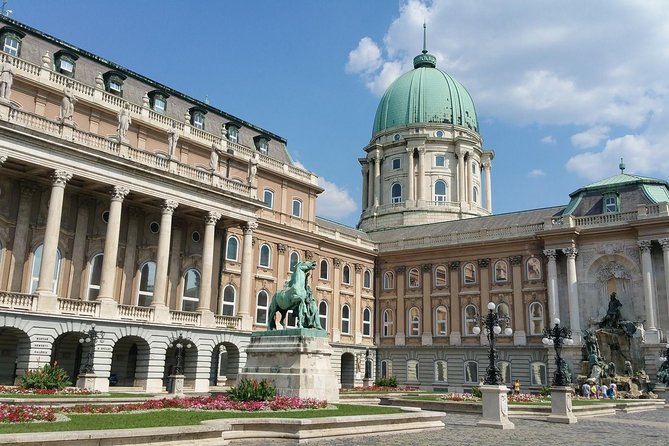
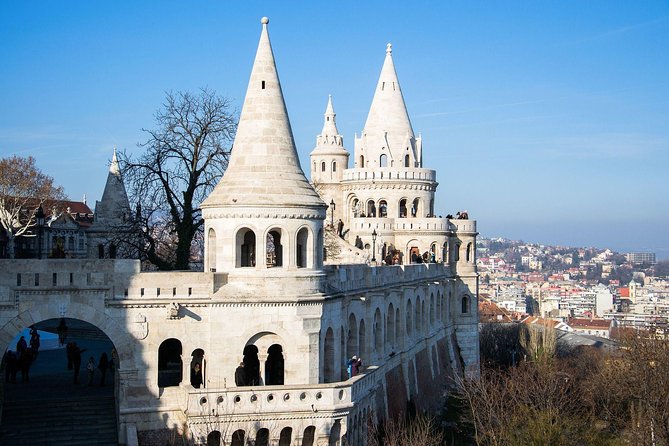
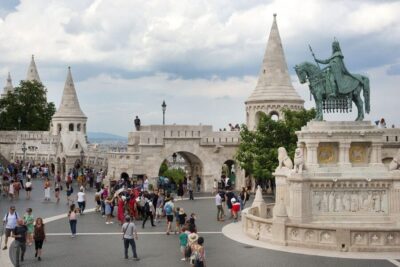
Fisherman’s Bastion is another place where appearances can fool you. Its towers and terraces look medieval, yet the structure was designed and built between 1895 and 1902 in Neo-Gothic and Neo-Romanesque styles.
The seven towers represent the seven Magyar tribes that settled in the Carpathian Basin at the end of the ninth century. That symbolism gives the lookout a national story, while the architecture supplies a dramatic setting for photographs.
The terrace looks over the Danube toward Pest, Margaret Island, and Gellért Hill. This is the tour’s broadest city view, and it gives you a chance to understand Budapest’s layout rather than simply admire a distant skyline.
The planned stop is about 20 minutes, and admission is not included. The extra ticket is worth considering if you want access to the paid sections, but check the exact entry arrangement when booking because the guided walk itself does not cover it.
I would not treat Fisherman’s Bastion as just a viewpoint. Its design, date, and seven-tower symbolism are part of the lesson. The guide’s job is to explain why a relatively modern structure was built to look like a romantic medieval fortification.
Vienna Gate closes the story
The tour ends at Vienna Gate, on the northern side of Castle Hill. From here, you can see toward Óbuda, or Old Buda, where the Romans founded the city known as Aquincum.
This is a fitting endpoint because it widens the story beyond the royal hill. You finish by looking toward the Roman roots of the city, after spending the walk tracing medieval kings, Renaissance ambition, Ottoman rule, Habsburg control, and modern Hungary.
The ten-minute stop is brief, but it gives the route a clear finish. Since the tour does not loop back to the starting point, note the ending location when making plans for lunch, a museum visit, or your next transport connection.
What the private price really means
The price is $397.36 per group of up to 10 people. That is a high total for a walking tour, but the calculation changes if you are traveling with family or friends. Split among 10 people, it works out to roughly $39.74 per person. Split among four, it is about $99.34 each. For one or two people, the value is harder to defend unless private guiding is a top priority.
The price includes a three-hour guided walk and a professional guide. It does not include food, drinks, Matthias Church admission, or Fisherman’s Bastion admission. There is no need to pay for a vehicle as part of the normal tour, since this is a walking experience.
The strongest value comes from the depth of explanation. A short public walk may cover the same buildings, but this format gives you a better chance to ask about the palace’s many rebuilds, the role of the Turkish pashas, or the reason Fisherman’s Bastion looks older than it is.
The group rules need a careful reading. The tour is advertised for up to 10 people, while the booking information also states a maximum of eight people per booking and a maximum of 10 on the activity. If your group is larger than eight, confirm the arrangement with Insight Cities before paying.
The guides and the human side of the walk
The guide is the heart of this experience. Kata is specifically associated with an in-depth approach to Budapest and Castle Hill, and Julia is also named as a guide. The available information does not promise that either person will lead every departure, so treat those names as examples rather than a guarantee.
The most praised feature is the guide’s ability to make the past feel relevant and real. That is exactly what this route needs. The buildings alone can blur together, especially when a medieval-looking church is a later reconstruction and the palace has changed so many times.
A private setting also makes it easier to ask basic questions without feeling rushed. You can clarify the difference between Buda and Pest, ask why the palace has an eclectic appearance, or spend more time on the periods that catch your attention.
One note of caution: one piece of feedback expressed disappointment that the Buda Castle itself seemed not to exist. That reaction points to a real booking issue, not necessarily a flaw in the route. The palace is a large complex with a long record of destruction and reconstruction, not a single intact medieval castle chamber waiting behind a gate. Book this for historical interpretation and the Castle Hill setting, not for a perfectly preserved fortress interior.
Who should book this Castle Hill walk?
I would choose this tour if you want the story behind the buildings and prefer a private guide to a large group. It suits first-time visitors who want a clear introduction to Buda, as well as repeat visitors who want to understand the hill’s royal, Ottoman, Habsburg, and modern connections.
It is especially practical for a group of friends or family members who can share the $397.36 cost. The English-language format, morning or afternoon departures, and pickup option add flexibility.
I would think twice if you mainly want independent sightseeing, dislike paying extra for entry tickets, or expect a full tour of preserved palace rooms. The route is primarily a guided outdoor walk with selected sightseeing stops, and the palace’s present form reflects extensive rebuilding.
The experience has a five-star average from nine ratings, with particular emphasis on detailed historical background and guides such as Kata and Julia. That points to a tour whose success depends less on special access and more on the quality of the explanation you receive.
Should you book it?
Book this private Buda Castle tour if history matters to you, your group can share the cost, and you want someone to explain the confusing layers of Castle Hill. The palace, Matthias Church, Fisherman’s Bastion, and Vienna Gate are more rewarding when you understand what is original, what was rebuilt, and how each period changed the hill.
Skip it if you only need the viewpoints or want to explore at your own speed. You can see the main exteriors independently, but you will miss the focused narrative that gives the three-hour walk its value. If you do book, set aside extra money for Matthias Church and Fisherman’s Bastion, arrive 15 minutes early at Bálthazár, and keep your expectations centered on a living historic district rather than one intact medieval castle.
FAQ
Where does the Buda Castle tour start?
Unless hotel pickup has been arranged, the tour starts at Bálthazár, a hotel with a café at Országház utca 31, 1014 Budapest.
How early should I arrive?
You should meet your guide 15 minutes before the scheduled start time.
Where does the tour end?
The walk ends at Vienna Gate on Castle Hill.
How long does the experience last?
The guided walk lasts approximately three hours.
Is the tour private?
Yes. The experience provides a private guide for your group.
How many people can join?
The activity allows up to 10 people, although the booking information also gives a maximum of eight people per booking. Confirm the arrangement if your party has more than eight people.
Is hotel pickup available?
Pickup is offered if it has been arranged. Otherwise, you should meet the guide at the standard meeting point.
Are tickets to Matthias Church included?
No. Admission to Matthias Church is not included in the tour price.
Is admission to Fisherman’s Bastion included?
No. Fisherman’s Bastion admission is not included.
What language is offered?
The tour is offered in English.
Can I choose a morning or afternoon departure?
Yes. The experience offers a choice of morning or afternoon departure.
Can I cancel for a full refund?
Yes, if you cancel at least 24 hours before the experience start time. Cancellations made less than 24 hours in advance are not refunded, and changes within that period are not accepted.
Just added around Budapest
- Budapest: Private, Personalized Pub Crawl, 3 drinks included★ 4.5 · 3 reviews
- Private day trip from Budapest to Bratislava, Vienna, and back★ 3.5 · 3 reviews
- Budapest: Private Adventure Sightseeing Bicycle Tour★ 4.5 · 3 reviews
- Private Danube Bend tour – full day★ 4.5 · 3 reviews
- Budapest: Guided City Walking Tour in Buda and Pest★ 5.0 · 3 reviews
- Budapest Old Jewish Quarter History Private Walking Tour★ 5.0 · 3 reviews
- Lake Balaton Full Day Private Wine Tour★ 5.0 · 3 reviews
- Budapest Urban Feast – Food Tour with Wine Tasting & Coffee House★ 4.5 · 3 reviews
Buda Castle District Tours, compared.
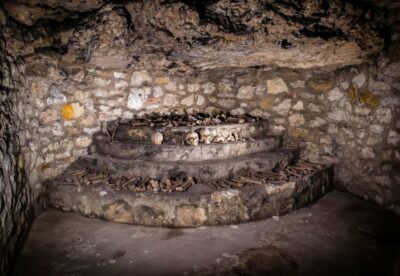

Buda Castle District Vampires and Myths Night Tour
Read our review →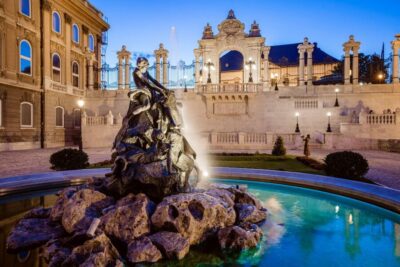

Buda Castle District Dark History, Legends and Vampire Night Tour
Read our review →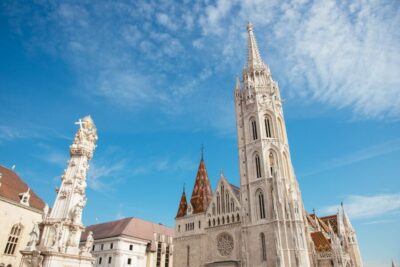
Buda Castle District Walking Tour with a Historian
Read our review →
Browse the lists this tour appears in