

Reviewed · CITY TOURS
Budapest: City Sightseeing Hop-On Hop-Off Bus Tour & Extras
Budapest is made for seeing from several angles, and this pass gives you three: the broad city view from an open-top bus, street-level detail on foot, and, when included or purchased separately, the Danube from the water. I especially like the 20-stop route and the freedom to ride the full 90-minute circuit first, then return to the places that catch your eye. The one-hour walk at 11am is another strong point, covering the basilica, Parliament, Shoes on the Danube Bank, Vaci Fashion Street, and the riverfront.
The main drawback is timing. Buses run roughly every 10 to 20 minutes, but the first departure is at 9am and the last from Stop 1 is at 5pm. The route can slow in traffic, and Budapest’s hills around Fisherman’s Bastion are not covered well, so you will still need to walk or arrange another ride for some of Buda’s best viewpoints.
Key points to know before you book

- A 24, 48, or 72-hour pass: The clock starts when you first use the ticket, not automatically at 9am on your first day.
- One full red-route circuit takes about 90 minutes: Ride once without getting off to plan your stops, then use the bus as city transport.
- The 11am walking tour is in English only: It begins at Szent Istvan ter by St Stephen’s Basilica and lasts one hour.
- The Danube cruise terms have changed: Bookings made before December 10 retain the cruise, while newer bookings may receive a discounted boat ticket instead.
- The bus covers both Pest and Buda, but not every hill: Fisherman’s Bastion and the upper Castle District require another plan.
- Audio commentary comes in 15 languages: English, Spanish, Turkish, Chinese, Finnish, French, German, Greek, Hebrew, Hungarian, Italian, Japanese, Arabic, Polish, Portuguese, and Russian are listed.
First ride: use the bus to get your bearings
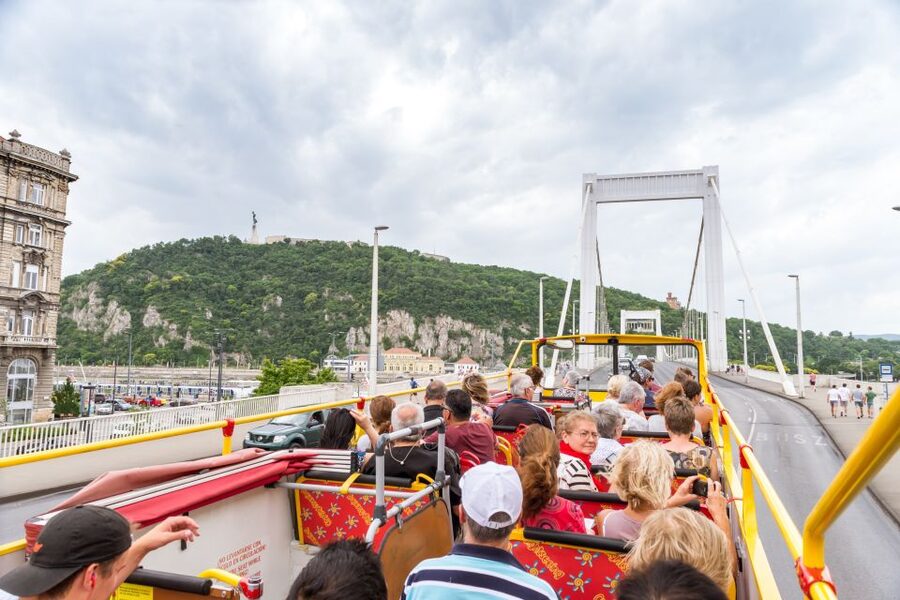
I would begin with one complete loop. You get a quick sense of how Budapest fits together: Pest spreads flat along the east bank, while Buda rises across the Danube in hills. The route also helps you decide which sights deserve your limited time and which are better admired from the upper deck.
The red route takes about 90 minutes, though traffic can stretch that time. Buses generally arrive every 10 to 20 minutes, with some periods closer to 25 minutes. That is frequent enough for a relaxed day, but you should not treat the timetable like a railway schedule.
Your pass is valid for 24, 48, or 72 hours from first use. This detail matters. If you board at noon on Tuesday, a 72-hour pass can carry you until noon Friday, not simply through the end of Friday. The longer options can be good value if the price difference is small, since you can use the bus for transport as well as sightseeing.
Some buses have a roof or covered sides, while others provide a more open view. That can be welcome in bad weather, but it may reduce your photographs and make the ride hot in summer. A few buses have scratched or marked side panels, and the public-address system is not always clear. The recorded audio generally works better than live announcements.
A few more Budapest half-days to weigh up
- Budapest: City Highlights Cruise with Welcome Drink
★ 4.6 · 35,610 reviews - Budapest City Landmarks Walking Tour in 2 Hours
★ 5.0 · 2,048 reviews - Budapest: Danube River City Lights Express Cruise
★ 4.1 · 1,608 reviews
Stops 1 to 4: basilica, bridge, and the Jewish Quarter
Stop 1, St Stephen’s Basilica, is the natural starting point. The great church dominates its square, and the 11am walking tour begins here at Szent Istvan ter 1. If you want the walk, arrive early enough to find the meeting point without rushing.
From here, Stop 2 at Chain Bridge on the Pest side puts you beside one of Budapest’s classic river crossings. The bridge links Pest and Buda, with the Castle District rising beyond it. This is a good place to combine bus travel with a walk along the Danube, though you should watch the route direction so you do not board the wrong way.
Stop 3, Jozsef Attila Street, is useful for central Pest and the area around the basilica. It is less of a headline attraction than Parliament or the synagogue, but it can save you a walk when you are moving between central sights.
Stop 4, Dohany Street Synagogue, takes you into Budapest’s historic Jewish Quarter. The synagogue, Jewish Museum, and memorial are major stops, but the bus ticket does not include entry fees. Check opening times separately before you hop off, since the pass is transport and commentary, not an attraction ticket.
Stops 5 and 12 are both listed as Astoria, and both are temporarily closed in the supplied route information. Do not plan a precise meeting point around Astoria until you confirm its current status. This is also a reminder to carry the paper map given on the bus, since online and printed route maps may not always match.
Stops 6 to 11: Andrassy Avenue and grand Pest
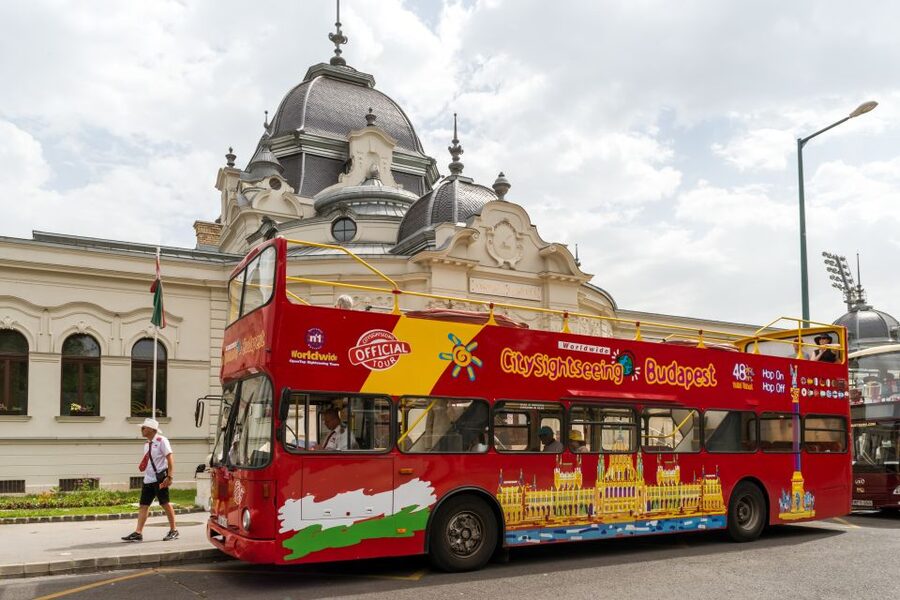
Stop 6, Andrassy Avenue, is your gateway to one of Budapest’s most elegant avenues. It leads toward Heroes’ Square and gives you access to several central neighborhoods. I like this stop for breaking up the bus ride with a long, straight walk rather than trying to see the avenue through a window.
Stop 7, the Hungarian State Opera House, is an easy choice for architecture lovers. Even if you do not enter, the stop places you near the city’s grand theatrical quarter. The audio commentary adds useful context as you ride, though sound quality can vary from bus to bus.
Stop 8, Liszt Ferenc Square, is another handy central stop, surrounded by restaurants and cafes. It works well as a lunch break, but food and drinks are not included in the pass, so plan for those costs separately.
Stop 9, Heroes’ Square, gives you one of Budapest’s broadest monumental spaces. It is also close to the City Park area. You can spend a little time here, then continue by bus rather than walking all the way back toward central Pest.
Stop 10, Keleti Railway Station, is practical as much as scenic. It connects the route with one of the city’s major rail terminals, though finding the exact bus stop near the station can take patience. Use the map and allow extra time if you are meeting the bus here.
Stop 11, New York Palace, brings you back toward central Pest. The historic cafe is the attraction most people associate with this stop, but entry and refreshments are your own expense. It is a convenient place to change the pace from monuments to grand interiors and city streets.
Stops 13 to 17: the Danube, Gellert Hill, and Castle approaches
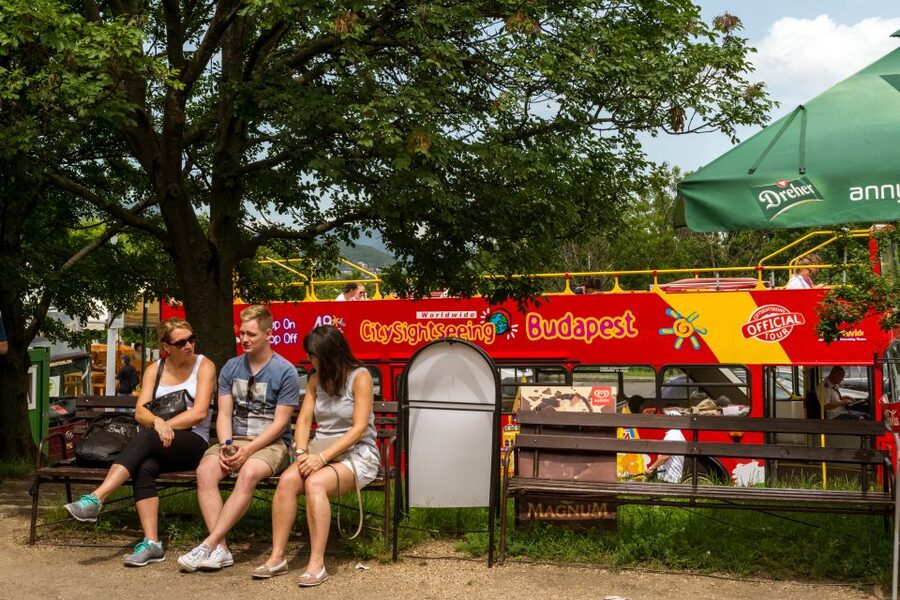
Stop 13, Parisi Passage Cafe, puts you near one of central Budapest’s most ornate passages. This is a good stop for architecture and photographs, though the bus route is more useful here as a link between districts than as a substitute for walking.
Stop 14, Gellert Square, is on the Buda side near the famous thermal-bath area and the foot of Gellert Hill. The stop gives you a different feel from flat Pest, with the river and hills close by. The hill itself can be demanding, so do not pack too many uphill plans into the same afternoon.
Stop 15, Castle Garden, brings you to the lower approach to Buda Castle. This is one of the most useful stops for reaching the Castle District without dealing with parking or a long crossing from Pest. The bus gets you to the area, but the castle grounds cover plenty of ground once you get off.
Stop 16, Funicular, is another Castle-side stop. The funicular is an attraction with its own ticket, not part of the bus pass. It can help with the climb, but the upper Castle District still requires walking after you arrive.
Stop 17, Batthyany Square, offers one of the finest views across the Danube toward the Hungarian Parliament Building. This is a particularly smart stop if you want photographs of Parliament from the Buda bank. The view changes through the day, and an early or late visit can give you softer light.
The route does not carry you directly through every upper-Buda sight. Fisherman’s Bastion and the higher Castle Hill area are the clearest gaps. One useful tip from the practical experience of using this route is to consider a small blue Castle Hill vehicle instead of relying only on the funicular, especially if you want to cover a wider area.
Same city, a completely different way to spend an afternoon:
- Budapest: Unlimited Prosecco, Beer and Aperol Spritz Cruise
★ 4.8 · 25,310 reviews - Budapest: Széchenyi Spa Day Ticket with Optional Upgrades
★ 4.3 · 23,911 reviews - Budapest: Nighttime or Daytime Sightseeing Cruise
★ 4.2 · 21,062 reviews - Budapest: 1-Hour Evening Sightseeing Cruise with Drink
★ 4.5 · 8,330 reviews
Stops 18 to 20: Margaret Bridge, shopping, and Parliament
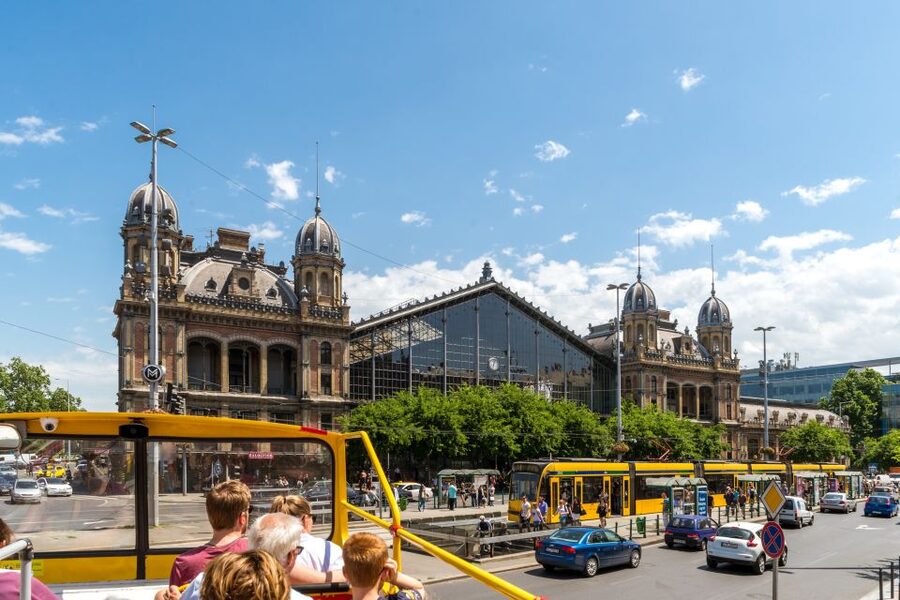
Stop 18, Margaret Bridge on the Buda side, connects the route with the northern central riverfront. From here, you can look toward Margaret Island, though this ticket does not turn the island into a full sightseeing stop. Check the exact boarding point carefully, since bridge stops can be less obvious than those on a normal street.
Stop 19, WestEnd Shopping Centre, is mainly practical. It can be useful for shopping, a break, or transport connections, but it is not a substitute for the old center’s architecture.
Stop 20, Parliament, is the grand finale of the red route. The Gothic Revival facade is best appreciated from across the river or from the Danube itself, while the bus gives you a useful approach and commentary. Parliament entry is not included, so you will need a separate ticket if you want to go inside.
This final section shows the strength and weakness of hop-on hop-off transport. You can reach the headline sights with little effort, but you still need to read the map, allow time for walking, and check the return direction. The red route runs one way, so an improvised zigzag can cost more time than expected.
The 11am walking tour fills in the gaps
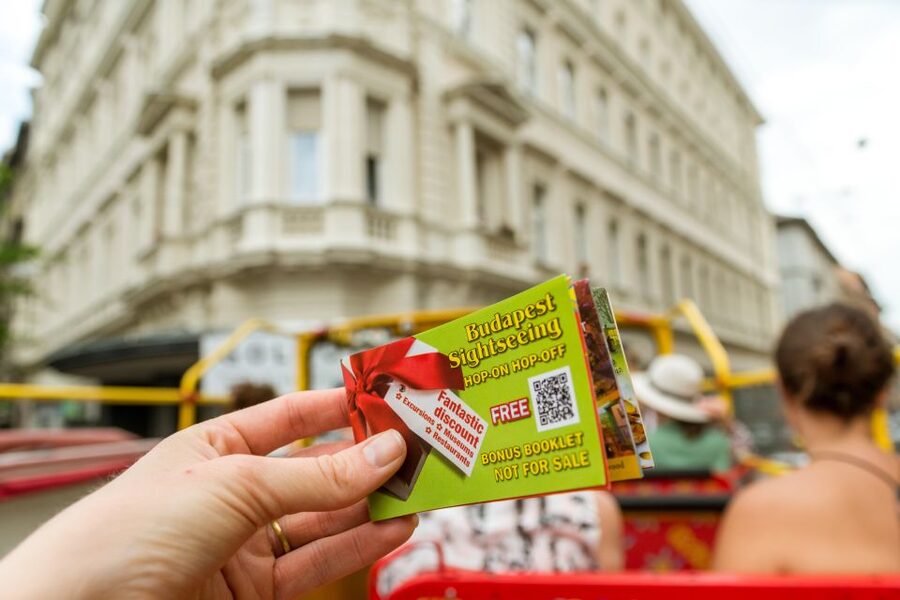
The included walking tour starts every day at 11am at St Stephen’s Basilica and lasts about one hour. It is narrated in English only, so the bus audio is the better option if you need another language.
The walk covers St Stephen’s Basilica, the Parliament area, the Shoes on the Danube Bank memorial, Vaci Fashion Street, and the Danube Promenade. These are places where a bus window cannot give you the full effect. At street level, you can pause, look closely, and hear the guide connect the monuments to Budapest’s past.
Guide quality can vary by date, but several named guides have drawn particular praise, including Claudia, Joan, Rebecca, and Souvar. Claudia is noted for an easy pace, humor, and strong command of Budapest’s story. Still, do not assume every departure has the same guide.
Instructions for extra walks around Buda can be unclear, and the stated daily walk is the one you should plan around. I would meet at the basilica rather than trying to join along the route. If the walk matters to you, build your morning around it and take the bus loop afterward.
Audio commentary and the view from the upper deck
The multilingual audio guide is one of the pass’s most useful features. You receive commentary in 15 languages, including English, Greek, Hungarian, Italian, German, French, Spanish, Portuguese, Polish, Russian, Turkish, Arabic, Hebrew, Chinese, Finnish, and Japanese.
Bring the headphones you receive when you first board. You may not automatically receive another pair later. The recorded narration is usually clearer than live announcements, which can be hard to hear through a weak microphone system.
The upper deck gives you the best view of Budapest’s facades and bridges, but it exposes you to sun, wind, and rain. Some buses have covered roofs, and some do not. On a warm day, the covered buses can feel hot, while on a cold day you may value the shelter more than the open view.
The Danube cruise: check the booking date carefully
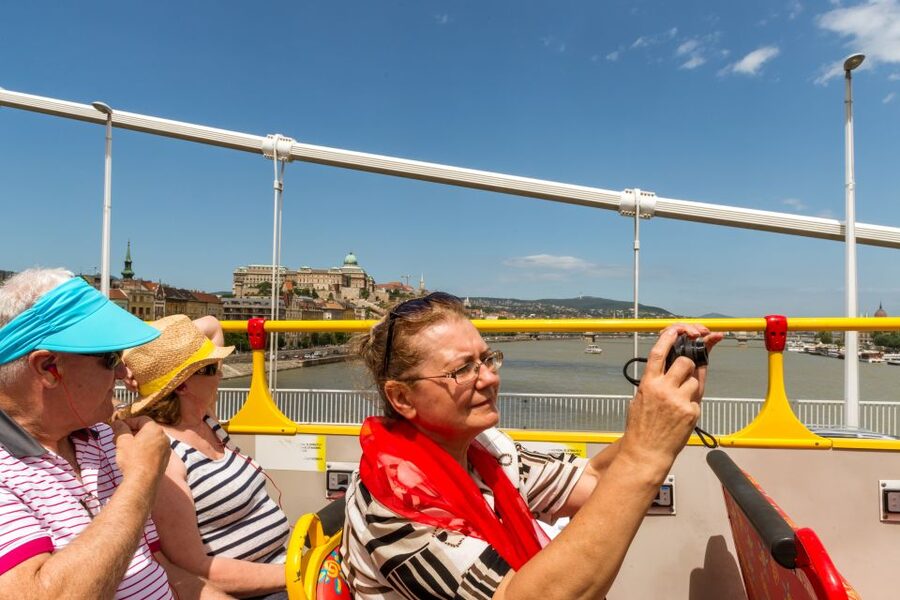
The boat is an appealing extra because Budapest’s most famous sights line the river. Parliament, the bridges, the hills of Buda, and the lower Castle area look different from the water. A daytime ride gives you a clear architectural view, while an evening departure can show the illuminated city.
The terms need special attention. For bookings made before December 10, the cruise is honored as included. For bookings made from Wednesday, December 10 onward, the boat tour is no longer included, but you can buy a ticket for HUF 3,500 instead of HUF 5,000 by showing your bus ticket at the departure point.
The cruise lasts about one hour according to the supplied details. Seating on the upper deck may be uncomfortable, and indoor seating can be limited in poor weather. The boat commentary may also be less clear on the top deck. I would choose a 9pm departure for illuminated buildings if that time is available, but confirm the current sailing schedule before making a fixed plan.
Is $41 good value for one to three days?
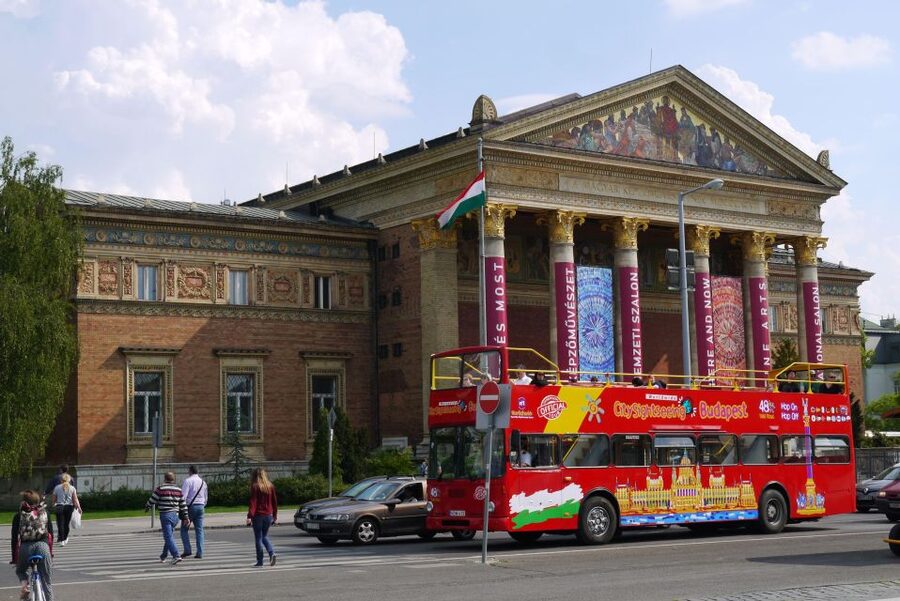
At $41 per person, the pass makes the most sense if you use it more than once. A single 90-minute circuit can be useful for orientation, but it is harder to justify the full price if you never get off and already plan to use public transport.
The value improves quickly with a 48-hour or 72-hour option. Several users have found that the two-day pass costs only a little more than the one-day version, and the extra time lets you use the bus as a practical link between attractions. The 72-hour ticket is especially useful if you want a slow first day, a museum or bath day, and a final round of favorite views.
You also receive a discount booklet for selected attractions. It does not replace admission tickets, but it can reduce the total cost if you choose one of the participating sights. Since the walking tour is included, the pass can work well for a first visit when you want a ready-made introduction rather than several separate bookings.
Traffic is the cost of convenience. Budapest streets can slow the buses, and service ends relatively early. After 5pm from Stop 1, you may need the metro or another form of transport to return to the center. The green route is reported to run only about once an hour, so I would not build a tight itinerary around it.
Who should choose this Budapest pass?
I would recommend it to you if this is your first visit, you want to cover both sides of the Danube, or you prefer not to work out every tram and metro connection. It is also helpful for anyone who cannot comfortably walk across the city all day.
Families and mixed-age groups can benefit from the flexible stops. You can ride past a sight, change your mind, and get off later without buying another ticket. It is also a sensible rainy-day backup, since a covered bus lets you continue seeing the city when long walks are unpleasant.
Independent visitors who enjoy wandering may find the fixed route limiting. The bus does not cover every upper-Buda hill, and it misses some useful points such as the Central Market Hall. If you already understand Budapest’s public transport, you might prefer paying for individual attractions and using ordinary city transit.
The buses are wheelchair accessible. Pets are not allowed, apart from service dogs, and smoking is prohibited. Mobile and printed vouchers are accepted, and you can redeem them at stops along the route. Cancellation is free up to 24 hours before the activity, and reserve-now, pay-later booking is available.
Should you book it?
Book this tour if you want an easy first look at Budapest, value a flexible 48-hour or 72-hour pass, and like having the walking tour and possible Danube cruise gathered in one package. The strongest combination is a full loop on day one, the 11am walk, then targeted stops at Parliament, Heroes’ Square, Gellert Square, Castle Garden, and Batthyany Square.
Choose the longer pass if the price difference is modest. Use the first ride for orientation and the later rides for transport. Just check the cruise terms, confirm the current Astoria closures, and make a separate plan for Fisherman’s Bastion and the upper Castle District.
FAQ
How long is the hop-on hop-off pass valid?
You can choose a 24-hour, 48-hour, or 72-hour pass. Its validity begins when you first use the ticket.
What time does the red route operate?
The first departure from Stop 1 is at 9am, and the last departure from Stop 1 is at 5pm. Buses run about every 10 to 20 minutes, and a full circuit takes around 90 minutes.
Where does the walking tour start?
The walking tour starts daily at 11am from Szent Istvan ter 1, 1051, Hungary, beside St Stephen’s Basilica.
How long is the walking tour?
The walking tour lasts one hour and is conducted in English only.
Is the Danube cruise included?
Bookings made before December 10 retain the boat tour. For bookings made from December 10 onward, the cruise is no longer included, but you can buy a boat ticket for HUF 3,500 instead of HUF 5,000 by showing your bus ticket.
Which languages are available for the audio guide?
The audio guide is available in English, Spanish, Turkish, Chinese, Finnish, French, German, Greek, Hebrew, Hungarian, Italian, Japanese, Arabic, Polish, Portuguese, and Russian.
Are the buses wheelchair accessible?
Yes. The buses are wheelchair accessible. Pets are not permitted, except for service dogs, and smoking is not allowed.
Just added around Budapest
- Budapest: Private, Personalized Pub Crawl, 3 drinks included★ 4.5 · 3 reviews
- Private day trip from Budapest to Bratislava, Vienna, and back★ 3.5 · 3 reviews
- Budapest: Private Adventure Sightseeing Bicycle Tour★ 4.5 · 3 reviews
- Private Danube Bend tour – full day★ 4.5 · 3 reviews
- Budapest: Guided City Walking Tour in Buda and Pest★ 5.0 · 3 reviews
- Budapest Old Jewish Quarter History Private Walking Tour★ 5.0 · 3 reviews
- Lake Balaton Full Day Private Wine Tour★ 5.0 · 3 reviews
- Budapest Urban Feast – Food Tour with Wine Tasting & Coffee House★ 4.5 · 3 reviews
City Tours, compared.

Budapest City Landmarks Walking Tour in 2 Hours
Read our review →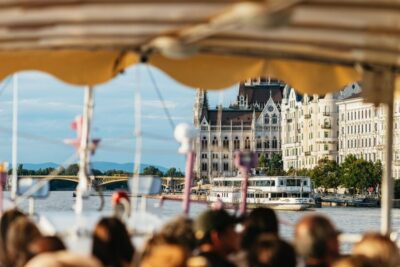

Hungarian Chimney Cake Workshop in the City Center
Read our review →


Private Budapest City tour with Classic Russian Jeep or G-Wagon!
Read our review →Browse the lists this tour appears in